
Navigating the complexities of working in a new country can be daunting, but Canada offers a highly sought-after pathway for many foreign nationals: the Open Work Permit (OWP). An Open Work Permit is a flexible authorization that allows eligible foreign nationals to work for almost any employer in Canada, in most occupations, and in virtually any location, without needing a specific job offer or Labour Market Impact Assessment (LMIA) upfront.
This flexibility sets it apart from employer-specific work permits, which bind workers to a single employer, making the OWP a powerful tool for career exploration and professional development in the Canadian labor market. Many individuals, including international students, spouses of temporary residents, and permanent residence applicants, benefit immensely from this permit.
This comprehensive guide aims to be your definitive resource for the Canada Open Work Permit in 2026. We’ll delve into everything you need to know, from understanding its fundamental characteristics and various types to navigating the application process, fees, processing times, and crucial policy updates. Our goal is to empower you with accurate, up-to-date information directly from official Immigration, Refugees and Citizenship Canada (IRCC) sources, enabling you to confidently pursue your Canadian work aspirations.
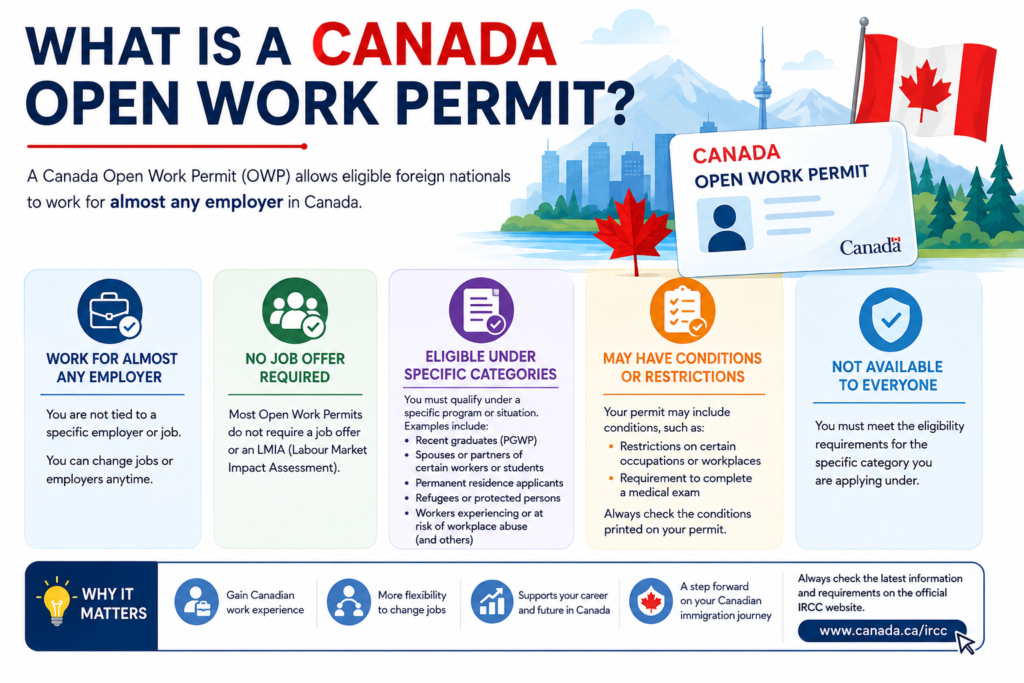
What is a Canada Open Work Permit?
At its core, a Canada Open Work Permit (OWP) grants foreign nationals the freedom to work for nearly any employer in Canada, in almost any job, and in any location across the country, subject to a few specific exceptions. Unlike an employer-specific work permit, which ties an individual to a designated employer, role, and work location, the OWP provides unparalleled flexibility. This means that with an OWP, you are not dependent on a particular job offer or an employer completing a Labour Market Impact Assessment (LMIA) – a process often required for closed work permits to prove that no Canadian worker is available for the job.
The primary advantages of holding an Open Work Permit are significant:
- Flexibility: You can apply for and accept any eligible job offer without needing a new work permit, allowing you to explore various industries and roles.
- Career Exploration: It provides an excellent opportunity to gain diverse Canadian work experience, which can be invaluable for future career prospects and permanent residence applications.
- Adaptability: If your initial job doesn’t work out, you can easily switch employers without impacting your immigration status.
The authority responsible for issuing these permits is Immigration, Refugees and Citizenship Canada (IRCC), the Canadian government department overseeing immigration and citizenship matters. For instance, unlike Sarah, who must work for Company X as specified on her employer-specific work permit, Ahmed, with his OWP, has the freedom to work for Company A, Company B, or even start looking for a different opportunity, adapting his career path as he sees fit in Canada.
For more detailed information on specific work permits, you can refer to the official IRCC page on employer-specific work permits.
General eligibility criteria for an open work permit
While specific eligibility requirements vary depending on the type of Open Work Permit you’re applying for, there are fundamental criteria that almost all applicants must meet. These baseline requirements are crucial for any temporary resident seeking to work in Canada. According to IRCC, you must:
- Prove you have sufficient funds to support yourself and any accompanying family members during your stay in Canada.
- Be in good health and be prepared to undergo a medical examination if required.
- Have no criminal record and obtain a police certificate if requested.
- Convince an immigration officer that you will leave Canada voluntarily at the end of your authorized stay.
- Comply with all previous Canadian immigration laws and have a clean immigration history.
It’s also vital to be aware of factors that could lead to inadmissibility – grounds under Canadian immigration law that can prevent a person from entering or remaining in Canada. These can include criminality, security concerns, misrepresentation on an application, or health risks that could pose an excessive demand on Canada’s health services. Meeting these general conditions is paramount, in addition to fulfilling the specific requirements of your chosen OWP stream. For instance, demonstrating financial stability might involve providing recent bank statements showing a consistent balance sufficient to cover living expenses for several months.
Types of Canada Open Work Permits and their specific eligibility
Canada offers several avenues to obtain an Open Work Permit, each catering to different circumstances. Understanding the specific eligibility for each type is crucial for a successful application. All information, especially for 2026, has been verified with IRCC sources to ensure accuracy.
Post-Graduation Work Permit (PGWP)
The Post-Graduation Work Permit (PGWP) is a highly popular Open Work Permit stream designed for international students who have successfully graduated from eligible Canadian Designated Learning Institutions (DLIs). Its primary purpose is to allow these graduates to gain valuable, skilled Canadian work experience, which often serves as a significant stepping stone towards permanent residence.
To be eligible for a PGWP in 2026, you must:
- Have graduated from an eligible Designated Learning Institution (DLI) – a school approved by a provincial or territorial government to host international students.
- Have completed a study program of at least eight months in length that led to a degree, diploma, or certificate.
- Have maintained full-time student status during each academic session of your program (with approved exceptions, such as authorized leaves or final academic sessions).
- Apply within 180 days of receiving your official transcript and an official letter from your DLI confirming the completion of your program.
The validity period of a PGWP can be up to three years, depending on the length of your study program. For example, a program between eight months and two years generally grants a PGWP for the same length as the program, while a program of two years or more can lead to a three-year PGWP. It’s important to note that the PGWP is generally a one-time opportunity; you can only receive one in your lifetime.
Imagine Sarah, who completed a two-year master’s program at a DLI. After receiving her final transcript and degree, she applies for her PGWP within the 180-day window and is granted a three-year permit, giving her ample time to work and gain Canadian experience. This experience is often crucial for programs like the Canadian Experience Class (CEC).
For detailed guidance, refer to the official IRCC page on the Post-Graduation Work Permit.
Spousal Open Work Permit (SOWP)
The Spousal Open Work Permit (SOWP) is a crucial pathway for families seeking to build a life together in Canada. It allows the spouse or common-law partner of certain temporary residents to obtain an Open Work Permit, enabling them to work for almost any employer in Canada.
Eligibility for an SOWP in 2026 is primarily dependent on the status of the principal applicant (the individual already in Canada on a temporary permit):
- Spouses of International Students: If the principal applicant is an international student holding a valid study permit and studying at a DLI in a degree-granting program (or certain diploma/certificate programs), their spouse may be eligible.
- Spouses of Skilled Workers: If the principal applicant holds a valid work permit and is employed in a skilled occupation (National Occupational Classification (NOC) TEER 0, 1, 2, or 3), their spouse may be eligible.
- Spouses of PGWP Holders: Spouses of individuals holding a Post-Graduation Work Permit (PGWP) may also be eligible for an SOWP.
In all cases, the relationship requirements are paramount: you must provide proof of a legal marriage or a common-law partnership (having lived together in a conjugal relationship for at least one year). IRCC emphasizes the genuineness of the relationship. The SOWP’s validity period is typically tied to the principal applicant’s status, meaning it will usually expire no later than the principal applicant’s study or work permit. For example, if David is studying for his master’s degree in Vancouver on a valid study permit, his wife, Maria, can apply for an SOWP. Once approved, Maria will be able to work anywhere in Canada, supporting their family and gaining her own Canadian work experience.
For the latest details, visit the official IRCC page on Spousal Open Work Permits.
Bridging Open Work Permit (BOWP)
The Bridging Open Work Permit (BOWP) is a vital provision designed to prevent a gap in legal work status for eligible permanent residence (PR) applicants who are already in Canada. Its purpose is to allow these individuals to continue working while Immigration, Refugees and Citizenship Canada (IRCC) processes their application for permanent residence.
To be eligible for a BOWP in 2026, you must:
- Have an active permanent residence application under one of the eligible economic immigration programs. These typically include:
- Federal Skilled Worker Program (FSWP)
- Canadian Experience Class (CEC)
- Federal Skilled Trades Program (FSTP)
- Provincial Nominee Programs (PNP) – if you’ve received a nomination that is unrestricted
- Quebec Skilled Worker Program (QSWP)
- Currently hold a valid work permit, or have maintained status (implied status) and be authorized to work, or be eligible to restore your status and hold a work permit.
- Be physically present in Canada at the time of your BOWP application.
The BOWP acts as a bridge, not a permanent solution, and its validity is typically granted until a decision is made on your permanent residence application. For instance, if a skilled worker, Sarah, is working in Toronto on a Post-Graduation Work Permit and has successfully submitted her Express Entry application under the Canadian Experience Class, she can apply for a BOWP. This ensures she can continue her valuable work in Canada even if her PGWP expires before her PR application is finalized, preventing any interruption in her employment.
More information can be found on the IRCC page on Bridging Open Work Permits.
International Experience Canada (IEC) / Working Holiday
The International Experience Canada (IEC) program is a unique youth mobility initiative that allows young individuals from partner countries to travel and work in Canada. Among its various streams, the Working Holiday stream is particularly popular, granting an Open Work Permit to eligible participants.
For the 2026 season, general eligibility criteria for the Working Holiday stream typically include:
- Age Limits: You must generally be between 18 and 30 or 18 and 35 years old, depending on your country of citizenship and the bilateral agreement Canada has with that country.
- Nationality: You must be a citizen of one of Canada’s partner countries with a bilateral youth mobility agreement.
- Financial Proof: Demonstrate sufficient funds at the time of your arrival in Canada to cover the initial period of your stay (e.g., CAD $2,500).
- Insurance: Obtain health insurance for the duration of your stay.
- Previous Participation: You may have limits on how many times you can participate in the IEC program or specific streams.
The IEC program operates on a pool and invitation system. Eligible candidates first submit a profile to a pool, and IRCC then sends out Invitations to Apply (ITAs) to select candidates. For example, a young person from Ireland, aged 25, can enter the IEC Working Holiday pool. If invited, they can apply for an Open Work Permit, allowing them to spend up to two years traveling and working across Canada, gaining invaluable international experience.
Check the official IRCC page on International Experience Canada for specific country requirements and the latest updates.
Vulnerable Worker Open Work Permit
The Vulnerable Worker Open Work Permit is a critical measure implemented by IRCC to safeguard the well-being of foreign workers in Canada. This permit is specifically designed to protect foreign nationals who are experiencing, or are at risk of experiencing, abuse in the context of their employment in Canada.
Eligibility for this specialized OWP in 2026 requires that the worker:
- Currently holds an employer-specific work permit.
- Is experiencing abuse (or is at risk of abuse) from their employer. This abuse can manifest in various forms, including physical, psychological, financial, or sexual mistreatment, as well as exploitation through unsafe working conditions or unreasonable demands.
- Applies for this permit from within Canada.
The core benefit of the Vulnerable Worker Open Work Permit is that it allows the worker to leave their abusive employer immediately and seek new employment elsewhere without jeopardizing their immigration status. This provides a vital pathway to safety and stability. For instance, if a foreign worker, Maria, arrived in Canada on a work permit tied to a specific employer who then began withholding wages and creating unsafe working conditions, Maria could apply for a Vulnerable Worker Open Work Permit. Once approved, she would be free to leave that employer and find a new, safe job.
For comprehensive details on this permit, please refer to the IRCC page on the Open Work Permit for Vulnerable Workers.
Open Work Permits for Refugee Claimants and Protected Persons
Canada provides a crucial lifeline to individuals seeking safety and protection within its borders by offering Open Work Permits to eligible refugee claimants and those who have been granted protected person status. These permits are fundamental in allowing vulnerable individuals to support themselves and integrate into Canadian society while their claims are processed or after their status is confirmed.
For Refugee Claimants: If you have made a refugee claim in Canada, you may be eligible for an Open Work Permit under certain conditions. This typically requires that:
- Your refugee claim has been referred to the Immigration and Refugee Board of Canada (IRB) for a decision.
- There are no reasons for inadmissibility that would prevent you from receiving a work permit.
- You have passed a medical exam, if required.
For Protected Persons: Individuals who have been determined to be a Convention refugee or a person in need of protection by Canada’s Immigration and Refugee Board are generally eligible for an Open Work Permit as a right, once their protected person status is officially recognized. The process for protected persons is usually straightforward after the status grant, ensuring they can promptly begin working.
These permits are vital for allowing refugee claimants to provide for their basic needs and for protected persons to rebuild their lives in Canada. For example, a refugee claimant who has had their claim referred to the IRB and passed their medical examination can apply for an OWP, allowing them to work and gain independence while awaiting a decision on their claim.
Further information is available on the IRCC page detailing work permits for refugee claimants.
Other specific open work permit categories
Beyond the most common types, IRCC issues Open Work Permits under various other specific circumstances and temporary public policies to address unique needs or economic priorities. While less frequent, these categories contribute to the comprehensive nature of Canada’s work permit system. For 2026, some of these could include:
- Family Members of Foreign Representatives: Spouses and dependent children of accredited foreign diplomats or consular officers stationed in Canada.
- Certain Participants in the Atlantic Immigration Program (AIP): While most AIP work permits are employer-specific, there can be provisions for open work permits under specific conditions related to the program.
- Temporary Public Policies: The Canadian government occasionally introduces temporary public policies in response to specific events (e.g., humanitarian crises) or economic needs, which may include provisions for Open Work Permits. It is crucial to check the official IRCC website for any new or extended public policies relevant to 2026.
How to apply for a Canada Open Work Permit
Applying for an Open Work Permit requires careful attention to detail and a thorough understanding of the process. Following these steps diligently will significantly increase your chances of a successful application in 2026.
Gathering your documents and information
The foundation of a successful Open Work Permit application lies in submitting accurate and complete documentation. Incomplete applications are a primary reason for processing delays or outright refusals. Based on IRCC guidelines for 2026, here’s a detailed checklist of common essential documents you’ll need to prepare:
- Valid Passport: Ensure your passport is valid for at least the entire duration of the work permit you are applying for.
- Proof of Temporary Resident Status: If applying from within Canada, this includes your current study permit, work permit, visitor record, or other immigration documents.
- Educational Documents (for PGWP): Official transcript and a letter of completion from your Designated Learning Institution (DLI).
- Relationship Proof (for SOWP): Marriage certificate or proof of common-law partnership (e.g., shared lease agreements, joint bank accounts, utility bills in both names).
- Financial Proof: Bank statements, employment letters, or other documents demonstrating sufficient funds to support yourself and your family in Canada.
- Digital Photo: A recent passport-sized photograph meeting IRCC specifications.
- Police Certificates: If required, from any country where you have spent six or more consecutive months since the age of 18.
- Medical Exam Results: If required for your country of origin or if you’ve resided in certain countries for a specified period.
- Family Information Form: Details about your family members, whether they are accompanying you or not.
It’s a practical tip to start gathering these documents well in advance of your application. Ensure all documents are translated into English or French by a certified translator if they are in another language. Additionally, be prepared to provide your biometrics (fingerprints and a photo) and undergo a medical examination if necessary. Biometrics are typically required for most work permit applicants unless you are exempt, and medical exams are needed if you have lived or traveled in specific countries or territories for more than six months in the past year. IRCC will send you instructions on how and where to provide these once your application is submitted.
For the most current and specific document checklists for various OWP types, always refer to the IRCC website.
Completing the application form
The vast majority of Open Work Permit applications are now processed online through the IRCC secure portal. This digital platform streamlines the application process, but it demands precision. To apply online, you will first need to create an IRCC account, which acts as your secure gateway to the application forms and submission portal.
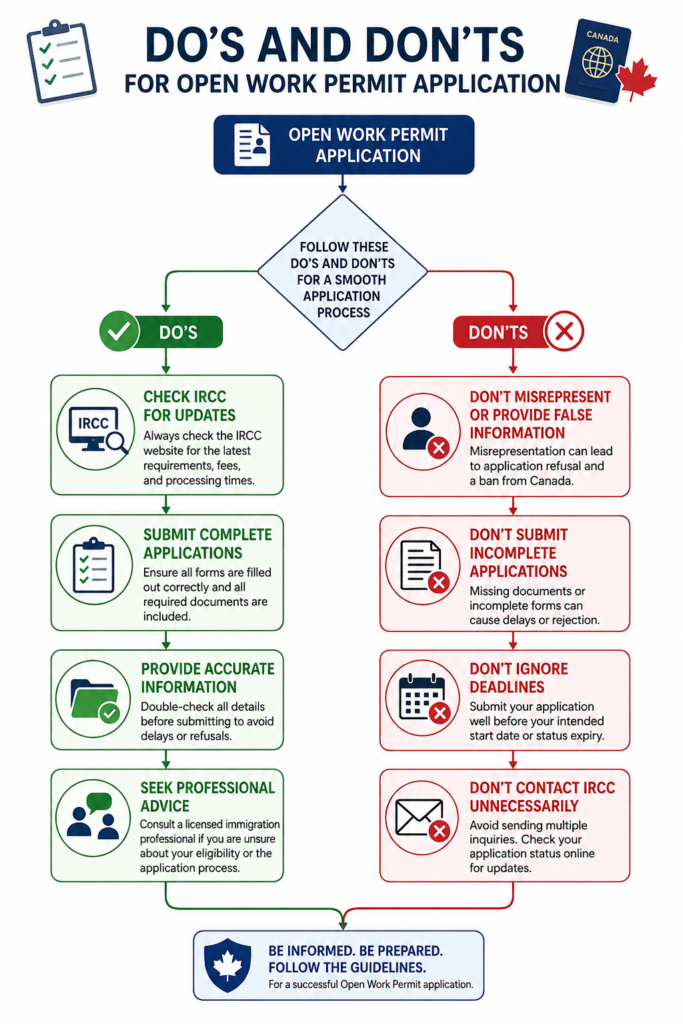
When completing the application form, whether online or, in rare circumstances, on paper, it is crucial to:
- Answer All Questions: Ensure every mandatory field is accurately completed. Blank fields or “N/A” when an answer is expected can lead to processing delays or refusal.
- Be Truthful: Any misrepresentation or false information can lead to severe consequences, including refusal and a ban from reapplying for several years.
- Double-Check: Before submission, meticulously review all entries for typos, factual errors, or inconsistencies.
Common mistakes I’ve observed when working with students include miscalculating dates, omitting travel history, or not fully explaining gaps in employment or study. For those rare situations where a paper application is necessary, you can find the relevant forms and mailing instructions on the official IRCC application forms page.
Paying the fees
Applying for a Canada Open Work Permit involves specific fees that must be paid at the time of application submission. These fees are subject to change, so always verify the most current amounts on the IRCC website for 2026.
Typically, you will encounter the following fees:
- Work Permit Processing Fee: This standard fee covers the cost of processing your work permit application. For 2026, this is CAD $155.00.
- Open Work Permit Holder Fee: This additional fee is specific to Open Work Permits, granting the holder the flexibility to work for any eligible employer. For 2026, this fee is CAD $100.00.
- Biometrics Fee: If you are required to provide biometrics, there will be a separate fee. For 2026, this is CAD $85.00 for a single person.
The most common and preferred method of payment is online through the IRCC secure portal using a debit or credit card. It is essential to ensure that your payment goes through successfully, as a failed payment will result in your application being considered incomplete and returned. Always keep a record of your payment receipt.
For current fee schedules, please consult the IRCC page on fees for work permits.
Submitting your application
Once you have gathered all your documents, accurately completed the application form, and paid the necessary fees, the final step is to submit your application to IRCC. For online applications, this involves uploading all supporting documents to your IRCC account, providing an electronic signature, and clicking the “submit” button. You will then receive an immediate Acknowledgment of Receipt (AOR) and an application number, which you can use to track your application status.
If you are submitting a paper application (which is rare for most OWP types), ensure your complete package is mailed to the correct IRCC processing centre as specified in the application guide. I always advise students to create a comprehensive checklist to ensure every single required document and form is uploaded or included before final submission. This meticulous approach minimizes the risk of a refusal due to missing information. It’s also crucial to keep a digital or physical copy of all submitted documents and any correspondence with IRCC for your records.
You can access the IRCC online portal login to manage your application.
Fees, processing times, and work permit validity
Understanding the financial commitment, anticipated waiting periods, and the duration of your Open Work Permit is crucial for effective planning of your Canadian journey. All information here is based on IRCC guidelines and verified for 2026.
Summary of Fees (2026)
As discussed, the primary fees associated with an Open Work Permit application are:
| Fee Type | Current Amount (CAD – Verify 2026) |
|---|---|
| Work Permit Processing Fee | $155.00 |
| Open Work Permit Holder Fee | $100.00 |
| Biometrics Fee (per person) | $85.00 |
Always double-check these amounts on the official IRCC website before applying, as they can change without prior notice.
Processing Times
The time it takes for IRCC to process an Open Work Permit application can vary significantly. These ‘processing times’ are estimates and depend on several factors, including:
- The type of Open Work Permit you are applying for (e.g., PGWP, SOWP, BOWP).
- Whether you are applying from inside or outside Canada.
- The country from which you are applying.
- The completeness of your application package.
- The volume of applications IRCC is currently receiving.
For example, as of 2026, processing times for a Post-Graduation Work Permit applied for within Canada might range from 2 to 4 months, while an SOWP for a spouse applying from overseas could take 6 to 9 months. These are only hypothetical ranges, and actual times are updated regularly. I always advise my students to use the official IRCC processing times tool for the most accurate and up-to-date estimates for their specific application type.
Work Permit Validity
The validity period of your Open Work Permit is also determined by its type:
- Post-Graduation Work Permit (PGWP): Up to three years, depending on the length of your study program in Canada.
- Spousal Open Work Permit (SOWP): Typically tied to the validity of the principal applicant’s study or work permit.
- Bridging Open Work Permit (BOWP): Valid until a decision is made on your permanent residence application.
- International Experience Canada (IEC) / Working Holiday: Usually 12 or 24 months, depending on the bilateral agreement with your country of citizenship.
Crucially, no Open Work Permit can be issued for a period longer than the validity of your passport or other travel documents. It’s essential to monitor your application status online regularly and be aware of your permit’s expiry date to plan for extensions or transitions to permanent residence.
Can you work while waiting for an Open Work Permit decision?
This is a common and critical question for many applicants. The ability to work while your Open Work Permit (OWP) application is being processed depends largely on your current status in Canada and the type of application you submitted.
The key concept here is ‘implied status,’ also known as ‘maintained status.’ If you apply for an extension of your existing work permit (or a new work permit) from within Canada before your current status expires, you are said to have implied status. This means you can legally remain in Canada under the same conditions as your previous permit until a decision is made on your new application.
Working under Implied Status:
- If you held a valid work permit and applied for an extension of that work permit or a new work permit (including an OWP) before its expiry, you can generally continue to work under the same conditions as your previous permit until IRCC makes a decision.
Important Clarifications:
- First OWP from within Canada: If you are applying for your first Open Work Permit from within Canada (e.g., transitioning from a visitor visa to an OWP), you generally cannot work until your OWP is approved and issued. There might be rare exceptions under specific temporary public policies, but you must verify these directly with IRCC for 2026. For example, some temporary public policies during the COVID-19 pandemic allowed visitors to apply for and receive work permits from within Canada, even working while they waited, but these are exceptions and not standard procedure.
- Maintaining Status: It is paramount to apply before your current immigration document (e.g., study permit, work permit) expires. If your document expires and you haven’t applied for an extension or new permit, you lose your legal status in Canada and must apply to restore your status, which can be complex and may prevent you from working.
Working illegally can have severe consequences, including removal from Canada and future inadmissibility. Always ensure you maintain valid status and adhere to the regulations.
Important considerations and recent updates for 2026
Staying informed about critical factors and policy changes is essential for a successful Open Work Permit application. Here, we’ll cover common pitfalls, the latest IRCC updates for 2026, and potential future policy discussions.
Common Reasons for Refusal
Applications are often refused for preventable reasons. Based on IRCC’s observations and my experience, common reasons for OWP refusal include:
- Incomplete Application: Missing forms, documents, or unsigned declarations. Even a single omitted piece of information can lead to refusal.
- Insufficient Funds: Failure to provide adequate proof of financial capacity to support yourself and any accompanying family members.
- Not Meeting Eligibility Criteria: Failing to satisfy the specific requirements for the particular OWP stream (e.g., not graduating from an eligible DLI for a PGWP, or the principal applicant not meeting NOC skill level requirements for an SOWP).
- Misrepresentation: Providing false information or withholding material facts. This is a serious offense that can lead to a multi-year ban from Canada.
- Security or Medical Inadmissibility: Having a criminal record, posing a security risk, or having health conditions that could be an excessive demand on Canadian health services.
- Failure to Convince of Intent to Leave: The officer is not convinced you will leave Canada at the end of your authorized stay.
To avoid these pitfalls, I strongly advise all applicants to thoroughly review the IRCC document checklist for their specific OWP type, gather all required evidence, and ensure every piece of information is accurate and consistent across all forms and documents.
Latest IRCC Policy Changes for 2026 (VERIFY)
As of August 30, 2026, Immigration, Refugees and Citizenship Canada (IRCC) continues to refine its immigration policies to meet Canada’s economic and social needs. While there have been continuous updates, no major, overarching changes to the *fundamental eligibility criteria* for the primary Open Work Permit streams (PGWP, SOWP, BOWP, IEC) have been announced for the entirety of 2026 that would drastically alter the core requirements outlined in this guide.
However, IRCC consistently adjusts program delivery instructions, temporary public policies, and processing priorities. For instance, specific temporary public policies that arose during earlier periods (e.g., related to post-secondary international students or visitors applying for work permits from within Canada) have either concluded or been updated. It is always critical to check the IRCC Newsroom and Ministerial Instructions for any targeted updates affecting specific cohorts or regions for 2026.
Potential Future Frameworks / Discussions
There have been ongoing discussions and proposals within the Canadian immigration landscape regarding potential future frameworks to streamline and modernize the work permit system. One such concept that has been informally discussed is a “Work Licence Framework.” This is *not* a confirmed policy for 2026, nor has IRCC officially announced its implementation or a concrete timeline. Instead, it represents a conceptual discussion aimed at potentially shifting Canada’s approach to temporary foreign workers in the long term.
What the “Work Licence Framework” might entail (if officially adopted): While details are scarce and purely speculative without official IRCC announcements, the concept could involve a more standardized, possibly tiered, “license” for foreign workers, rather than the current system of diverse permit types. This could aim to simplify categories, potentially offer more worker mobility, or integrate temporary work with permanent residence pathways more seamlessly. However, as of August 30, 2026, this remains a speculative future direction and is *not* an active policy or framework governing Open Work Permits. It’s crucial to distinguish between active policy and exploratory discussions. Any significant changes would be publicly announced by IRCC through official channels.
Tips for a Successful Application
- Start Early: Give yourself ample time to gather documents, complete forms, and address any potential issues.
- Accuracy is Key: Double-check all information for correctness and consistency.
- Seek Professional Guidance: If your case is complex or you are unsure, consider consulting a Regulated Canadian Immigration Consultant (RCIC) or an immigration lawyer.
- Maintain Valid Status: Always ensure you have valid legal status in Canada, especially if applying from within the country.
- Keep Records: Retain copies of everything you submit, along with all correspondence from IRCC.
Pathways after your Open Work Permit: Building towards Permanent Residence (PR)
An Open Work Permit is often much more than just a temporary authorization to work; for many, it serves as a critical stepping stone towards achieving Canadian Permanent Residence (PR). The invaluable Canadian work experience gained through an OWP significantly boosts eligibility for various PR programs.
Here’s how an OWP can propel you towards PR:
- Canadian Experience Class (CEC): The CEC, managed under the Express Entry system, is designed for skilled workers who have Canadian work experience. Gaining at least one year of full-time (or equivalent part-time) skilled work experience through your OWP can make you eligible for this highly popular pathway.
- Provincial Nominee Programs (PNP): Each Canadian province and territory operates its own PNP, allowing them to nominate individuals who meet their specific labor market needs. Many PNPs prioritize candidates with Canadian work experience, especially if that experience is in an in-demand occupation within the province.
- Federal Skilled Worker Program (FSWP): While not strictly requiring Canadian work experience, experience gained through an OWP can still improve your overall Comprehensive Ranking System (CRS) score under Express Entry, making you a more competitive candidate for the FSWP.
Beyond work experience, holding an OWP allows you to live and work in Canada, providing opportunities to improve your English or French language proficiency, build professional networks, and adapt to Canadian life. All these factors contribute positively to your future PR application scores or eligibility. For instance, an international student who graduates and obtains a PGWP can work in a skilled occupation for a year. This experience, combined with their Canadian education and improved language skills, can make them an ideal candidate for Express Entry under the Canadian Experience Class, ultimately leading to an Invitation to Apply for Permanent Residence.
To explore these pathways further, consult the IRCC page on Express Entry and Permanent Residence.
Frequently asked questions
What is the main difference between an open work permit and an employer-specific work permit?
The core distinction lies in flexibility. An Open Work Permit allows you to work for almost any employer in Canada, in most occupations, and in any location, without needing a specific job offer or Labour Market Impact Assessment (LMIA). In contrast, an employer-specific (or “closed”) work permit restricts you to working for a particular employer, in a specific job, and often at a designated location, as detailed on the permit itself. The OWP offers immense freedom to explore the Canadian job market, while the employer-specific permit requires a pre-arranged job.
How long can I stay in Canada on an Open Work Permit?
The duration of your stay on an Open Work Permit varies significantly depending on the type of permit. For example, a Post-Graduation Work Permit (PGWP) can be valid for up to three years, based on the length of your study program. A Spousal Open Work Permit (SOWP) is typically tied to the validity of the principal applicant’s study or work permit. International Experience Canada (IEC) permits, like the Working Holiday stream, are usually granted for 12 or 24 months. Importantly, your OWP cannot be valid for longer than your passport.
Can I extend my Canada Open Work Permit?
The possibility of extending your Open Work Permit depends on its specific type and if you continue to meet the eligibility criteria. For example, a Post-Graduation Work Permit (PGWP) is generally a one-time issuance and not renewable. However, some SOWPs may be extended if the principal applicant’s status is also extended. If you are applying for an extension from within Canada before your current permit expires, you can benefit from “implied status” (maintained status), allowing you to continue working under the same conditions until a decision is made on your extension application. Always check the specific program guidelines on the IRCC website for your OWP type for 2026.
What happens if my Open Work Permit application is refused?
If your Open Work Permit application is refused, IRCC will send you a refusal letter stating the reasons. Common reasons include incomplete applications, not meeting eligibility criteria, or concerns about your intent to leave Canada. Your options typically include: requesting an explanation through an Access to Information and Privacy (ATIP) request to understand the specific grounds for refusal; reapplying with corrected information, stronger evidence, or addressing the stated reasons for refusal; or seeking professional legal advice from a Regulated Canadian Immigration Consultant (RCIC) or an immigration lawyer to assess your options and strategy.
Do I need a job offer to get an Open Work Permit in Canada?
Generally, no, you do not need a job offer to obtain an Open Work Permit in Canada. This is its primary advantage, offering you the flexibility to search for employment once you arrive in Canada or within Canada without being tied to a specific employer. While some specialized streams, like the Vulnerable Worker OWP, arise from a previous job context, the permit itself grants you open work authorization. This flexibility stands in direct contrast to employer-specific work permits, which always require a valid job offer and often an LMIA.
The Canada Open Work Permit offers an incredible opportunity for foreign nationals to gain valuable work experience and contribute to the Canadian economy. Its inherent flexibility, allowing holders to work for almost any employer, is a significant advantage, differentiating it from more restrictive employer-specific permits. Whether you’re an international student transitioning to post-graduation work, a spouse seeking to join your partner, or a permanent residence applicant bridging your status, understanding the specific type of OWP relevant to your situation is paramount.
Yes Study has explored the diverse categories, from the popular Post-Graduation Work Permit to specialized options like the Vulnerable Worker OWP, and detailed the meticulous application process from document gathering to submission. As an expert in this field, I cannot stress enough the critical importance of consulting official Immigration, Refugees and Citizenship Canada (IRCC) resources for the most up-to-date information, particularly regarding fees, processing times, and any policy changes specific to 2026. Armed with accurate knowledge and a confident approach, you can navigate this crucial step in your Canadian journey effectively. Remember, careful preparation and adherence to IRCC guidelines are your best allies for a successful Open Work Permit application.
