
The Canada Super Visa is a unique multi-entry temporary resident visa designed to facilitate extended visits for parents and grandparents of Canadian citizens and permanent residents. In 2026, this program continues to be an invaluable pathway for family reunification, allowing eligible individuals to stay for up to five years per entry, with the possibility of extending their stay for an additional two years, totalling up to seven consecutive years.
The visa itself can remain valid for up to 10 years, or until the passport expires, offering unparalleled flexibility compared to a regular visitor visa. Navigating the Super Visa application successfully requires a clear understanding of its specific requirements, from eligibility criteria and mandatory insurance to financial thresholds (LICO) and the application process itself. This comprehensive guide will demystify every essential aspect, focusing on accurate, up-to-date information for 2026, empowering you to confidently reunite your family in Canada.
What is the Canada Super Visa?
The Canada Super Visa is a distinct multi-entry visa crafted exclusively for the parents and grandparents of Canadian citizens or permanent residents. Its primary purpose is to enable long-term family visits, allowing for significant periods of time together without the frequent administrative burden of renewing visitor status.
The most compelling benefit of the Super Visa is its extended duration of stay. Unlike a regular visitor visa, which typically permits a stay of up to six months per entry, a Super Visa holder can remain in Canada for up to five years per entry. Furthermore, visitors can apply to extend their stay by up to an additional two years from within Canada, potentially allowing for a total continuous stay of seven years. The visa itself can be valid for up to 10 years, or until your passport expires, making it an exceptionally flexible option for sustained family reunification.
Imagine your parents or grandparents being able to spend years at a time watching their grandchildren grow, participating in family milestones, and truly settling into Canadian life, all without the constant stress of short-term visa renewals. This is the underlying goal of the Super Visa program – to foster deeper family connections and simplify the process for extended visits.
For more detailed information, you can always refer to the official IRCC page for the Super Visa program overview.
Eligibility requirements for the Super Visa
This section delves into the critical criteria that both the inviting Canadian citizen or permanent resident (sponsor) and the visiting parent or grandparent (applicant) must satisfy to be granted a Super Visa. Understanding these requirements is paramount for a successful application.
Sponsor requirements
To invite your parents or grandparents to Canada under the Super Visa program, you, as the sponsor, must meet specific conditions and demonstrate your commitment to their visit.
- Canadian Status: You must be a Canadian citizen or a permanent resident of Canada, or a person registered under the Canadian Indian Act. You must also be at least 18 years old and reside in Canada.
- Financial Commitment: A cornerstone of the Super Visa is your financial responsibility. You must meet the minimum necessary income (MNI) thresholds, commonly known as the Low Income Cut-Off (LICO), for your household size. More importantly, you must provide a written and signed commitment of financial support for your visiting family members for the entire duration of their stay.
- Proof of Relationship: You need to provide official documents proving your relationship to the applicant. This typically includes your birth certificate (showing your parents’ names) or a marriage certificate (for grandparents).
- Letter of Invitation: A valid and detailed letter of invitation is essential. This letter should explicitly state the purpose and estimated duration of the visit, confirm that you will provide financial and accommodation support, and outline your relationship with the applicant.
When preparing the invitation letter, I always advise students to make it as personal and detailed as possible. Don’t just use a generic template; explain the joy and benefit of having your parents or grandparents visit, how they will contribute to your family life, and how you will ensure their well-being. This personal touch can make a significant difference to the immigration officer reviewing the application.
Applicant requirements
For parents and grandparents applying for the Super Visa, several key conditions must be met to ensure eligibility and a smooth application process.
- Relationship to Sponsor: The applicant must be the parent or grandparent of a Canadian citizen or permanent resident. This relationship must be proven with official documents.
- Intent to Leave: Applicants must satisfy the immigration officer that they intend to leave Canada at the end of their authorized stay. This is a crucial aspect often demonstrated through strong ties to their home country, such as property ownership, stable employment, ongoing business interests, family responsibilities (e.g., other dependents), or significant financial assets.
- Immigration Medical Exam (IME): All Super Visa applicants are required to undergo an Immigration Medical Exam by an IRCC-approved panel physician.
- Admissibility: Applicants must be generally admissible to Canada. This means they must not have a serious criminal record, pose a security risk, or have health conditions that would cause excessive demand on Canada’s health or social services.
- Mandatory Medical Insurance: A critical and unique requirement for the Super Visa is obtaining valid Canadian medical insurance. This policy must provide at least $100,000 CAD in emergency medical coverage and be valid for a minimum of one year from the date of entry into Canada. It must be purchased from a Canadian insurance company or an OSFI-authorized foreign insurer and cover health care, hospitalization, and repatriation.
- Application from Outside Canada: The Super Visa application must be submitted while the parent or grandparent is physically outside Canada.
When working with students, I often highlight that showing strong ties to the home country is not just about documents; it’s about demonstrating a clear life, a reason to return, and not relying solely on a potential life in Canada. Providing comprehensive evidence, such as property deeds, marriage certificates of other family members remaining in the home country, or letters from employers confirming a job to return to, significantly strengthens this aspect of the application.
Understanding the Low Income Cut-Off (LICO)
The Low Income Cut-Off (LICO) is a crucial financial benchmark established by Immigration, Refugees and Citizenship Canada (IRCC) that sponsors must meet to prove their capacity to financially support their visiting parents or grandparents. The purpose of LICO is to ensure that Super Visa holders will not become a financial burden on Canadian public services during their extended stay.
The specific LICO amount required varies based on the size of the sponsor’s family unit. This family unit calculation includes: the sponsor, their spouse or common-law partner, any dependent children (regardless of custody arrangements), the parents and grandparents applying for the Super Visa, any existing Super Visa holders the sponsor is currently supporting, and any previously sponsored individuals for whom the sponsor is still financially responsible.
As of March 31, 2026, IRCC introduced new flexibilities in how they assess a sponsor’s income. Previously, only the most recent tax year’s income was considered. Now, sponsors (and their co-signers, if applicable) can demonstrate they meet the LICO threshold using their income from either of the two tax years immediately preceding the application. This is particularly helpful for families whose income might fluctuate year-to-year. Furthermore, if the host meets a minimum percentage of the required income, the income of the visiting parent or grandparent (such as from pensions, investments, or rental properties) can now be factored in to help meet the remaining LICO amount, provided it is properly documented.
Acceptable proofs of income typically include: the most recent Notice of Assessment (NOA) from the Canada Revenue Agency (CRA) (showing total income, Line 15000), T4 slips, employment letters detailing job title, date of hire, and salary, recent pay stubs (ideally covering 3-6 months), and bank statements. For self-employed individuals, an accountant’s letter confirming annual income is often required.
A common pitfall I’ve observed is when sponsors don’t have consistent income for the full 12-month period leading up to the application, or they rely on a single, unusually high month. While the new flexibilities help, consistent, verifiable income remains key. Always aim to provide comprehensive documentation that clearly illustrates your financial stability over time.
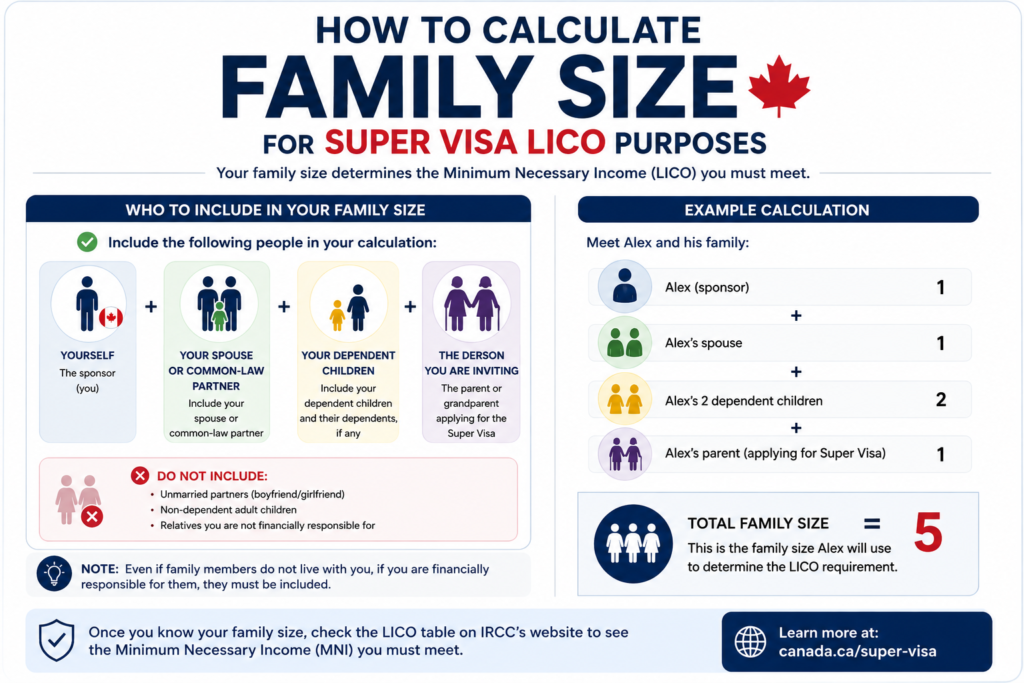
LICO Table for Super Visa Sponsors (Effective July 29, 2025, applicable for 2026 applications)
| Size of Family Unit | Minimum Income Required (LICO) |
|---|---|
| 1 person | $30,526 |
| 2 persons | $38,002 |
| 3 persons | $46,720 |
| 4 persons | $56,724 |
| 5 persons | $64,336 |
| 6 persons | $72,560 |
| 7 persons | $80,784 |
| Each additional person | +$8,224 |
Note: These LICO figures were updated on July 29, 2025, and remain applicable for 2026 Super Visa applications. Always refer to the official IRCC website for the most current LICO requirements.
Terms to define:
- Low Income Cut-Off (LICO): A measure of poverty in Canada, used by IRCC to determine the minimum income required for sponsors in various family sponsorship programs.
- Notice of Assessment (NOA): An official document issued by the Canada Revenue Agency (CRA) after processing an individual’s tax return, confirming their income and tax paid.
Mandatory Super Visa insurance requirements
The Super Visa features a unique and compulsory health insurance requirement that is vital for safeguarding both the visitor and the Canadian healthcare system. This section will outline everything applicants and sponsors need to know to secure the correct policy.
Key features of Super Visa insurance
Meeting the precise requirements for Super Visa insurance is non-negotiable for a successful application. IRCC has clear stipulations to ensure visitors are adequately covered during their extended stay in Canada.
- Minimum Coverage: The policy must provide at least $100,000 CAD in emergency medical coverage per person. This is the minimum set by IRCC, and many families opt for higher limits (e.g., $150,000 or $300,000) given the high cost of emergency medical care for non-residents.
- Duration of Coverage: Coverage must be valid for a minimum of one year from the date of the applicant’s entry into Canada. This means if your parents intend to stay for 5 years, the initial policy must cover the first 12 months, and they must maintain continuous valid insurance for the entire duration of their subsequent stays or extensions.
- Approved Insurer: The policy must be purchased from a Canadian insurance company or a foreign insurance company approved by the Minister of Immigration.
- Comprehensive Coverage: The policy must explicitly cover emergency medical care, hospitalization, and repatriation (the cost of returning remains to the home country in the event of death).
- Verifiable and Paid: Proof that the premium has been paid (either in full or with a deposit on a monthly plan) must be provided with the application. Insurance quotes are not acceptable. The policy must also be verifiable by a Border Services Officer upon entry to Canada.
- Exclusions: Be diligent in understanding common exclusions, such as pre-existing conditions not declared at the time of purchase, or elective procedures. Always disclose all health information to the insurer.
In my experience, a common mistake is purchasing a policy from a non-Canadian company that isn’t explicitly approved, or not ensuring the policy explicitly lists all required coverages (emergency medical, hospitalization, repatriation). A well-chosen policy might also offer direct billing to hospitals, which can prevent significant out-of-pocket expenses during an emergency. Ensure your policy documents clearly show the insured person’s full name, policy number, coverage amount, coverage period, insurer’s name, and confirmation of all required coverages. For official requirements, refer to the IRCC page on Super Visa insurance requirements.
Estimating Super Visa insurance costs
The cost of Super Visa insurance is often one of the most significant expenses for families, and it varies considerably based on several factors. Understanding these can help you budget effectively.
Key factors influencing the premium include: the applicant’s age (older applicants generally pay more), their health status (pre-existing conditions will impact the cost, often requiring a higher premium or resulting in exclusions), the chosen deductible, and the overall duration of coverage. While the policy must be valid for at least one year, some applicants may choose to purchase policies for longer if available and financially viable.
It’s highly advisable to compare quotes from multiple Canadian insurance providers. While the entire year’s premium must be paid upfront or guaranteed for the application, some providers offer monthly payment options after an initial deposit. Calling a few Canadian insurance providers and providing the applicant’s age and general health information can give you a good idea of the potential costs. This proactive step helps avoid surprises and allows you to find a competitive rate that meets all IRCC requirements.
Required documents for the Super Visa application
Submitting a complete and accurate set of documents is crucial for a successful Super Visa application. This section will detail the necessary paperwork for both the sponsor in Canada and the applicant overseas, ensuring nothing is overlooked.
Documents for the sponsor (in Canada)
As the Canadian sponsor, you play a pivotal role in the Super Visa application by providing essential documents that demonstrate your eligibility and commitment to your visiting family members.
- Proof of Canadian Status: A clear copy of your Canadian citizenship certificate, Canadian birth certificate, or Permanent Resident Card.
- Proof of Income: This is critical for meeting the LICO requirements. You will need:
- Your most recent Notice of Assessment (NOA) from the Canada Revenue Agency (CRA).
- T4 slips and/or T1 tax documents for the most recent tax year.
- An employment letter from your employer, on company letterhead, stating your job title, description, date of hire, and current annual salary.
- Recent pay stubs (e.g., covering the last 3 to 6 months).
- Bank statements showing consistent income over the last 12 months.
- For self-employed individuals, a letter from an accountant confirming your annual income.
- Letter of Invitation: A comprehensive and signed letter of invitation detailing:
- The purpose of the visit and your relationship to the applicant.
- The intended duration of their stay.
- Details about accommodation in Canada.
- Your unwavering commitment to financially support them during their entire visit.
- Proof of Relationship: Documents clearly establishing your familial link to the applicant, such as your birth certificate (showing your parents’ names) or a marriage certificate (if sponsoring grandparents).
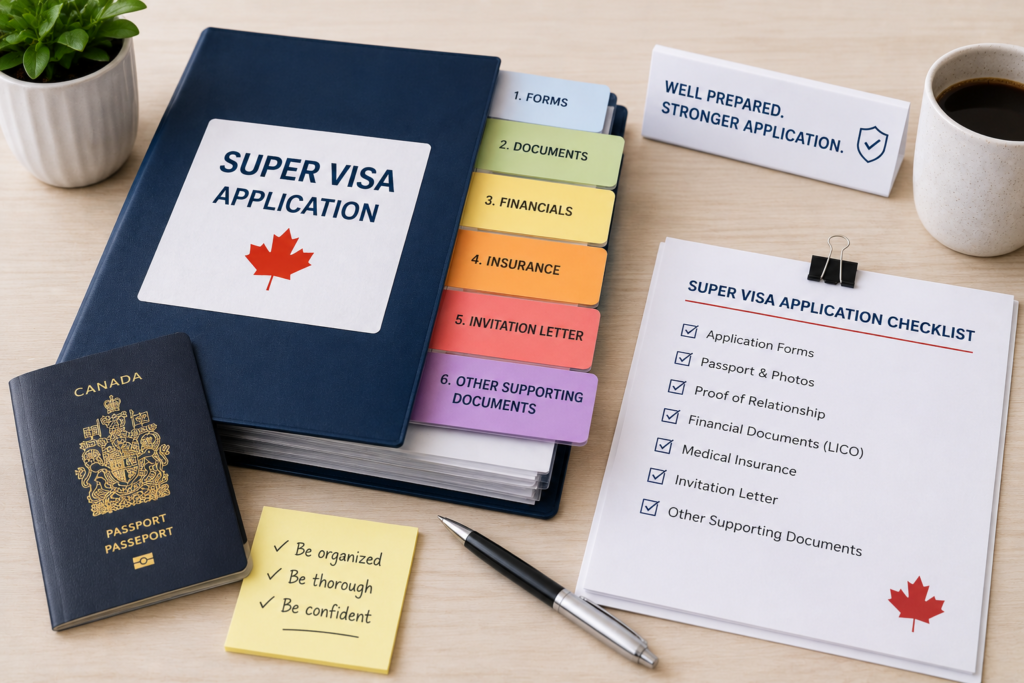
- Family Composition List: A list of all family members included in your LICO calculation, including their names and birthdates.
It’s important to remember that the invitation letter should be personalized and sincere, not just a generic template. It should reflect your genuine desire to have your family visit and your ability to support them. Always cross-reference the official IRCC document checklist for Super Visa sponsors to ensure all requirements for 2026 are met.
Documents for the applicant (outside Canada)
The parent or grandparent applying for the Super Visa from outside Canada must also meticulously gather a specific set of documents to support their application.
- Valid Passport: The applicant’s passport must be valid for at least 6 months beyond their intended stay in Canada, though some visa officers prefer validity beyond the entire Super Visa duration.
- Proof of Relationship: Official documents such as birth certificates or marriage certificates that clearly link the applicant to their Canadian child or grandchild.
- Proof of Super Visa Insurance: A copy of the insurance policy confirmation, explicitly highlighting:
- At least $100,000 CAD in emergency medical coverage.
- One-year validity from the anticipated date of entry.
- Confirmation that it’s from a Canadian insurance company or an OSFI-approved foreign insurer.
- Immigration Medical Exam (IME) Confirmation: Proof that the mandatory medical exam has been completed by an IRCC-approved Designated Medical Practitioner.
- Ties to Home Country: Comprehensive documentation demonstrating strong connections to their country of residence and an intent to leave Canada at the end of their authorized stay. This can include:
- Property deeds or rental agreements.
- Bank statements and other financial assets in their home country.
- Employment letters or proof of business ownership.
- Evidence of other family members remaining in the home country.
- Return flight reservations (if applicable for initial entry, though not always mandatory for application).
- Digital Photo: Meeting IRCC specifications.
- Completed Application Forms: All required IRCC forms (e.g., IMM 5257, IMM 5645) filled out accurately and completely.
- Police Certificates: If requested by IRCC, based on the applicant’s country of residence or travel history.
I always emphasize to applicants that providing as much evidence of ties to the home country as possible is critical. Immigration officers are looking for genuine intent to visit, not to immigrate permanently. A lack of sufficient proof of these ties is a common reason for refusal. For the official list, always consult the IRCC document checklist for Super Visa applicants.
Step-by-step Super Visa application process
Navigating the Super Visa application can seem daunting, but breaking it down into manageable steps makes the process clearer. This section provides a comprehensive guide from start to submission.
Preparing your application package
The initial stage involves gathering all necessary information and completing forms correctly, laying the groundwork for a strong application.
- Gather All Required Documents: Reiterate the importance of collecting all sponsor and applicant documents as detailed in the previous section. Use the official IRCC checklist to ensure nothing is missed.
- Complete IRCC Forms: Download the official application forms from the IRCC website. Key forms include the Application for Temporary Resident Visa (IMM 5257), Family Information (IMM 5645), and the Document Checklist (IMM 5484). Fill them out accurately and completely; inconsistencies or blank fields can lead to refusal.
- Translate Documents: If any supporting documents are not in English or French, they must be accompanied by certified English or French translations. These translations must also include an affidavit from the translator attesting to their accuracy.
- Pay the Application Fee: The application fee for a Super Visa is $100 CAD per applicant. Additionally, most applicants will need to pay an $85 CAD biometrics fee. You can typically pay these fees online through the IRCC portal.
I always advise applicants to double-check all forms for consistency in information and ensure all necessary fields are signed before submission. A meticulously prepared package greatly reduces the risk of delays or refusal.
Submitting the application
Once your package is ready, the next step is submission, followed by a crucial step for most applicants: biometrics.
- Online Submission (Preferred): Most applicants apply online through the IRCC secure portal. This method is generally preferred as it often leads to faster processing times and allows for real-time updates on your application status. You will create an account and upload all your documents electronically.
- Paper Application (If Applicable): While online submission is encouraged, a paper application option might be available for those who cannot apply online due to disability or technical issues. Instructions for mailing a paper application are available on the IRCC website.
- Biometrics Requirement: After submitting your application, most Super Visa applicants will receive a Biometrics Instruction Letter. This letter will direct you to provide your fingerprints and a photo at a designated Visa Application Centre (VAC) within 30 days. Biometrics are typically valid for 10 years.
- Application Receipt Confirmation: After successful submission, you will receive a confirmation, and it’s essential to regularly check your IRCC online account for any updates or requests for additional information.
Always keep an eye on your IRCC account for that biometrics instruction letter. Missing the 30-day window can cause significant delays. Submitting a comprehensive application from the outset can help streamline the process.
The immigration medical examination (IME)
The Immigration Medical Examination (IME) is a mandatory component of the Super Visa application, serving a crucial role in maintaining public health and safety in Canada.
- Purpose of IME: The primary reason for the IME is to ensure that applicants do not pose a public health or safety risk to Canada and will not place an excessive demand on Canada’s health or social services. This assessment helps protect the well-being of all Canadians.
- Who Needs an IME: All Super Visa applicants are required to undergo an IME. This applies to both parents and grandparents.
- How to Get an IME: You cannot use your regular family doctor for an IME. Applicants must visit a panel physician (also known as a Designated Medical Practitioner) who has been specifically approved by IRCC to conduct these exams. You can find a list of approved panel physicians in your country of residence using the official IRCC ‘Find a Panel Physician’ tool.
- What to Expect During the Exam: The IME typically involves a physical examination (including height, weight, vision, hearing, blood pressure), a review of your medical history, a urine test, a blood test, and a chest X-ray for applicants over 11 years old. In some cases, a mental status exam may be required for applicants over 75 or with specific medical conditions.
- Costs and Validity: The applicant is responsible for all costs associated with the IME, which can vary by physician and location. The results of an IME are generally valid for 12 months, so it’s important to plan your application timeline accordingly. Panel physicians will submit the results directly to IRCC via the eMedical system.
From experience, I advise getting the IME done early in the application process. Processing times for medical results can sometimes take several weeks, and any delays could impact your overall Super Visa timeline. Ensuring you have all necessary medical records and vaccinations up-to-date before your appointment can also help.
Super Visa vs. visitor visa: Which one is right for you?
Choosing between a Super Visa and a regular visitor visa is a common dilemma for families. While both allow temporary entry into Canada, their features, benefits, and requirements differ significantly. Understanding these distinctions is key to making an informed decision for your family’s specific needs.
The most prominent difference lies in the duration of stay. A regular visitor visa typically allows for a stay of up to six months per entry. In contrast, the Super Visa permits an initial stay of up to five years, extendable for an additional two years, for a total of seven consecutive years. This extended stay capability is the core advantage of the Super Visa.
Another crucial distinction is the mandatory requirements. A Super Visa application requires the Canadian sponsor to meet specific financial thresholds (LICO) and the applicant to obtain mandatory Canadian private medical insurance for at least one year. These are not typically required for a regular visitor visa, making the visitor visa application generally simpler and less costly upfront.
The validity period also varies. Both can be multi-entry, allowing multiple entries over a period of up to 10 years (or until passport expiry). However, the Super Visa is explicitly designed for the “long haul,” whereas a visitor visa is typically for shorter, more frequent visits.
Decision-making factors:
- If your parents or grandparents plan to visit for short durations, for example, 2-3 months annually, a regular visitor visa might suffice due to its simpler application process and lower initial costs.
- If, however, they envision spending several years consecutively with you, or wish to return frequently for extended periods over a decade, the Super Visa is unequivocally the better option. It alleviates the constant worry of renewing status and provides greater stability.
- Consider the financial capacity of the sponsor. Meeting the LICO and covering the insurance cost for a Super Visa requires a significant financial commitment.
- The health status of the applicant is also a factor, as the Super Visa requires an Immigration Medical Exam and comprehensive insurance coverage for potential health needs during their long stay.
In essence, the Super Visa is tailor-made for long-term family reunification, while the visitor visa serves for shorter, more casual visits. Choose the option that best aligns with your family’s travel plans and financial realities. For instance, if your parents plan to visit for a few months for a special event, a visitor visa would be simpler. But if they dream of spending significant time watching your children grow up, the Super Visa provides that unparalleled opportunity.
Comparison of Super Visa vs. Visitor Visa
| Feature | Super Visa | Visitor Visa |
|---|---|---|
| Purpose | Extended visits for parents & grandparents | General tourism, short family visits, business |
| Max Stay per Entry | Up to 5 years (initial), extendable by 2 years (total 7) | Usually up to 6 months |
| Max Total Validity | Up to 10 years (multi-entry) | Up to 10 years (multi-entry), but shorter stays per entry |
| Financial Requirement (Sponsor) | Mandatory LICO (Low Income Cut-Off) | Generally no specific income threshold (proof of funds for visitor’s stay is still needed) |
| Mandatory Insurance | Yes, $100,000 CAD from Canadian/approved insurer for 1 year | No, but recommended |
| Immigration Medical Exam (IME) | Mandatory | Required only in specific circumstances (e.g., specific jobs, living in certain countries) |
| Application Complexity | More complex (income proof, insurance, IME) | Generally simpler |
| Cost (IRCC Fee) | $100 CAD application + $85 CAD biometrics | $100 CAD application + $85 CAD biometrics (same TRV fee) |
| Right to Extend Stay in Canada | Easier to extend for up to 2 additional years as a visitor record holder | Possible, but decision relies on intent and circumstances, up to 6 months at a time |
Super Visa processing time and application cost
Understanding the expected processing times and overall costs is crucial for planning your Super Visa application effectively. These factors can vary, so it’s important to consult the most current information.
Processing Times
Super Visa processing times are not uniform; they can vary significantly based on several factors, including the applicant’s country of residence and the current workload of Immigration, Refugees and Citizenship Canada (IRCC). For example, as of August 2026, the estimated Super Visa processing time for applicants from India is around 56 days, while for the Philippines, it’s typically between 95 and 116 days (approximately 13 to 17 weeks). The general processing time across various offices is cited as approximately 132 days.
Factors that can influence processing time include:
- The completeness and accuracy of your application package.
- The volume of applications being processed at the specific visa office.
- How easily IRCC can verify the information and documents provided.
- Whether an interview or additional documents are requested.
- The time taken to provide biometrics (this is not included in the posted processing times).
I always advise applicants to check the official IRCC processing times tool regularly for the most up-to-date estimates for their specific country. A well-organized and complete application from the outset is your best strategy to avoid unnecessary delays.
Application Costs
The overall cost for a Super Visa application extends beyond just the government fees. Here’s a breakdown of potential expenses for 2026:
- IRCC Application Fee: $100 CAD per applicant for the Super Visa (which is a Temporary Resident Visa).
- Biometrics Fee: $85 CAD per applicant (if required). If a family of five or more applies together, the maximum family fee for TRV is $500 CAD, but biometrics are still $85 per person.
- Electronic Travel Authorization (eTA): For visa-exempt applicants flying to Canada, an eTA costs $7 CAD.
- Immigration Medical Exam (IME): The cost for the IME is paid directly to the panel physician and varies by country and clinic.
- Mandatory Super Visa Insurance: This is often the largest expense, with costs typically ranging from $1,000 to $5,000+ CAD per year, depending on the applicant’s age, health status, and chosen coverage.
- Other Potential Costs: These can include document translation fees, police certificates (if required), courier charges, and fees for professional assistance from an immigration consultant or lawyer, if you choose to use one.
Budgeting for these various costs in advance is essential to ensure a smooth application process. The mandatory insurance, in particular, should be carefully considered as a significant part of the overall Super Visa expense.
What happens after you apply?
Once your Super Visa application is submitted, you’ll naturally be curious about the next steps. This section clarifies the post-application journey, from receiving a decision to arriving in Canada and even extending a stay.
Super Visa approval and arrival in Canada
Receiving an approval for your Super Visa is an exciting moment, but there are still important procedures to follow both before and upon your arrival in Canada.
- Decision Notification: You will be notified of the decision on your application, typically through your IRCC online account or via email. If approved, you will receive a letter with instructions.
- Visa Stamp/eTA: For applicants requiring a Temporary Resident Visa (TRV), this letter will instruct you to submit your passport to a Visa Application Centre (VAC) to have the Super Visa counterfoil (sticker) placed in your passport. If you are from a visa-exempt country and flying to Canada, you will receive a letter of approval, and you may also need to apply separately for an Electronic Travel Authorization (eTA) before you travel.
- Port of Entry Procedures: Upon arrival at a Canadian airport or land border, you will interact with a Border Services Officer (BSO). The BSO will verify your identity, check your documents, and confirm your admissibility to Canada. Even with an approved Super Visa, the BSO has the final authority on allowing entry and determining the authorized length of stay.
- Duration of Stay: The BSO will typically grant an authorized stay of up to 5 years per entry. They will either stamp your passport with an expiry date or issue a visitor record, which is a separate document outlining the conditions and duration of your stay.
- Important Documents for Arrival: It is crucial to carry all supporting documents that you submitted with your application, including your invitation letter, proof of Super Visa insurance, and evidence of financial support. Have these readily accessible, not packed in your checked luggage, as the BSO may request to see them.
My advice is always to be prepared, polite, and truthful when speaking with the BSO. They are ensuring national security and adherence to immigration laws. Clear communication and having your documents organized can make your entry much smoother.
Extending your Super Visa stay in Canada
If your parents or grandparents wish to stay longer than the initial period granted at entry (up to 5 years), they can apply to extend their stay from within Canada.
- When to Apply: An application to extend their visitor status must be submitted *before* their current authorized stay expires. IRCC recommends applying at least 30 days before the expiry date.
- How to Apply: The process involves applying online through the IRCC portal for a “visitor record.” A visitor record is not a visa but a document that legally extends their stay as a temporary resident in Canada.
- Conditions for Extension: The extension can be granted for up to two additional years, allowing for a total continuous stay of up to seven years. The applicant must continue to meet Super Visa conditions, including maintaining valid private medical insurance for the entire extended period. They will also need to demonstrate they have sufficient funds to support themselves during the extended stay and still intend to leave Canada at the end of their authorized period.
- Implied Status: If an application for an extension is submitted before the current status expires, the applicant benefits from “implied status.” This means they can legally remain in Canada under the same conditions as their expired permit until IRCC makes a decision on their new application.
I always advise applying for an extension several months before the current visitor status expires. This allows ample time for processing, which can sometimes be lengthy, and ensures that implied status can kick in if a decision isn’t made immediately. Remember, extending your stay in Canada as a visitor does not renew your Super Visa (TRV) itself. If you leave Canada and wish to re-enter, you would need a valid TRV to do so.
Common reasons for Super Visa rejection and how to avoid them
While the Super Visa offers a fantastic opportunity for family reunification, applications can be refused if certain requirements are not met. Understanding the frequent causes of rejection can help you proactively mitigate these risks and significantly improve your chances of approval.
- Insufficient Funds (Sponsor): This is one of the most common reasons for refusal. If the Canadian sponsor fails to meet the Low Income Cut-Off (LICO) for their household size, or cannot provide adequate, verifiable proof of income (such as NOAs, T4s, or employment letters), the application will likely be denied.
- How to avoid: Ensure your income clearly meets or exceeds the LICO for your family size. Provide comprehensive and consistent income documentation for the required period. Remember the new 2026 flexibilities allow you to use either of the last two tax years and combine the applicant’s income if you meet a minimum percentage.
- Lack of Strong Ties to Home Country (Applicant): Immigration officers need to be convinced that the parent or grandparent intends to leave Canada at the end of their authorized stay. Insufficient evidence of social, economic, or familial ties to their home country often raises concerns about overstaying.
- How to avoid: Provide extensive documentation proving your connections to your home country. This includes property deeds, bank statements, stable employment letters, evidence of ongoing business interests, and proof of family members remaining in your home country (e.g., spouse, dependent children).
- Incomplete or Inconsistent Application: Missing forms, unsigned documents, outdated forms, or inconsistencies in information across various documents can lead to an immediate refusal.
- How to avoid: Use the official IRCC document checklist diligently. Double-check that all forms are filled out completely, accurately, and consistently, and that all required signatures are present. Always download the most current versions of forms from the IRCC website.
- Incorrect or Insufficient Medical Insurance: Failure to meet the strict Super Visa insurance requirements is a direct path to rejection. This includes policies with less than $100,000 CAD coverage, policies not valid for at least one year, or policies not purchased from a Canadian or approved foreign insurance company.
- How to avoid: Carefully review and ensure your insurance policy meets *all* IRCC specifications. Obtain confirmation of paid policy directly from the insurer and include it in your application.
- Health Inadmissibility: Issues arising from the Immigration Medical Exam (IME), such as a health condition deemed to pose a public health risk or place an excessive demand on Canada’s health services, can lead to refusal.
- How to avoid: While some health conditions are beyond control, being proactive by seeking treatment for minor issues before the exam and being completely transparent with the panel physician can help.
- Previous Immigration Violations: A history of overstaying a previous visa, misrepresentation on a past application, or other immigration infractions can significantly jeopardize a Super Visa application.
- How to avoid: Always be honest in your application. If there are past issues, it’s advisable to seek counsel from a Regulated Canadian Immigration Consultant (RCIC) or immigration lawyer to address them transparently and provide necessary explanations.
- Criminality or Security Concerns: Any serious criminal record or concerns about national security will render an applicant inadmissible to Canada.
- How to avoid: Ensure you have a clean criminal record. If you have any past legal issues, consulting an immigration professional is crucial to determine admissibility.

Frequently asked questions
Can I apply for a Super Visa from inside Canada?
Generally, no. Super Visa applications must typically be made from outside Canada by the parent or grandparent applicant. The Super Visa counterfoil (sticker) is issued by a visa office outside Canada. While visitors in Canada can apply to extend their stay via a visitor record, an initial Super Visa application usually requires the applicant to be outside the country.
How long can my parents or grandparents stay in Canada with a Super Visa?
With a Super Visa, your parents or grandparents can typically stay in Canada for up to five years per entry. Furthermore, they have the option to apply for an extension of up to two additional years from within Canada, potentially allowing a total continuous stay of seven years. The visa itself can be valid for up to 10 years, or until their passport expires. However, the Border Services Officer at the port of entry makes the final decision on the authorized length of stay upon arrival.
Is the Super Visa a multi-entry visa?
Yes, the Super Visa is indeed a multi-entry visa. This means that over its validity period (up to 10 years, or until passport expiry), the holder can enter Canada multiple times, with each individual stay potentially lasting for up to five years. This offers significant flexibility for parents and grandparents to visit their families frequently and for extended durations without needing to reapply for a visa each time.
What happens if I cannot meet the LICO requirements?
Meeting the Low Income Cut-Off (LICO) is a mandatory eligibility requirement for Super Visa sponsors. If you, as the sponsor, cannot meet the LICO threshold for your family size, or if you cannot provide sufficient proof of income, your Super Visa application will likely be refused. In such cases, you might explore alternative options like a regular visitor visa, which does not have a LICO requirement but typically limits stays to six months. We always recommend seeking advice from a Regulated Canadian Immigration Consultant (RCIC) or immigration lawyer to explore all possible avenues based on your specific financial situation.
Can Super Visa holders work or study in Canada?
No, the Super Visa is a temporary resident visa issued specifically for visiting purposes. It explicitly does NOT permit the holder to work or study in Canada. If a Super Visa holder wishes to work or study, they would need to apply for a separate work permit or study permit, respectively, and meet the specific eligibility criteria for those programs. These applications are entirely distinct from the Super Visa and have their own requirements and processes.
Conclusion
The Canada Super Visa stands as an unparalleled opportunity for extended family reunification, offering parents and grandparents the remarkable ability to spend years at a time with their loved ones in Canada. Its unique benefits, including stays of up to five years per entry and a validity of up to 10 years, clearly distinguish it from a regular visitor visa, making it an ideal solution for those seeking long-term connections.
As Yes Study‘ve explored, successful Super Visa applications in 2026 hinge on meticulous preparation and a thorough understanding of all eligibility requirements. From the sponsor’s crucial commitment to meeting the Low Income Cut-Off (LICO) – now with new assessment flexibilities allowing for more financial pathways – to the applicant securing mandatory Canadian medical insurance and demonstrating strong ties to their home country, every detail matters.
By carefully following this comprehensive guide, gathering all necessary documents, and proactively addressing potential pitfalls, you are well-equipped to navigate the Super Visa application process with confidence. We encourage you to take the next step towards making those cherished family reunions a long-lasting reality in Canada. Whether you choose to embark on the application journey independently or seek personalized advice from a qualified Regulated Canadian Immigration Consultant (RCIC) or immigration lawyer, the goal remains the same: bringing families closer, for longer.
