
If you have ever dreamed of waking up to snow-dusted pine forests in Banff, spending your weekends surfing on the rugged shores of Tofino, or navigating the buzzing, multicultural avenues of Toronto, then the Canada Working Holiday Visa is your ultimate ticket to adventure [1.5, 1.8]. Formally known as the Working Holiday category of the International Experience Canada (IEC) program, this initiative is tailored for young adults who want to explore one of the world’s most geographically diverse nations while earning money to fund their journey [1.5, 1.8].

Offering a highly coveted open work permit, the Working Holiday Visa provides the rare freedom to work for almost any employer, in almost any industry, and in any location across the country [1.5, 1.8]. In this comprehensive, expert-backed guide, we will unpack everything you need to know to successfully navigate the 2026 season [1.5, 1.13].
We will detail the core eligibility requirements—including age limits and proof of funds—walk you through the five-step application journey, itemize necessary documents, and offer practical, on-the-ground advice for launching your new life [1.5, 1.14]. Based on the latest updates from Immigration, Refugees and Citizenship Canada (IRCC), our goal is to simplify this multi-stage program so you can apply with confidence and embark on the travel experience of a lifetime [1.5, 1.14].
What is the Canada Working Holiday Visa (IEC)?
The Canada Working Holiday Visa is a stream within the International Experience Canada (IEC) program—a federal youth mobility initiative established by the Canadian government [1.5, 1.8]. Based on reciprocal bilateral agreements between Canada and over 35 partner countries, the program’s primary objective is to foster international youth mobility, promote cultural exchange, and allow foreign nationals to acquire valuable life and professional experience in Canada [1.8, 1.13, 1.14].
While some travel visas severely restrict your ability to earn an income, the IEC Working Holiday category grants you an Open Work Permit [1.5, 1.8]. Unlike employer-specific (closed) work permits, an open work permit does not require a prior job offer or a Labour Market Impact Assessment (LMIA) [1.8]. It allows you to change employers freely, work multiple jobs, or take extended breaks to travel whenever you choose [1.8].
The program offers unmatched flexibility, allowing you to craft a balance of work and play that suits your goals. Depending on your country of citizenship, your visa will be issued for a duration of either 12 or 24 months [1.8]. This flexibility makes it highly distinct from other IEC streams like the Young Professionals stream (which requires a skilled job offer in your field) and the International Co-op (Internship) stream (designed strictly for students completing mandatory work placements) [1.7, 1.8].
For most young travelers, the Working Holiday Visa is the preferred route due to its sheer versatility [1.7, 1.8]. You could spend a winter working as a ski instructor in Whistler, transition to a hospitality role in Calgary for the spring, and spend your summer exploring the Maritime provinces [1.2, 1.8].
Key benefits of the Working Holiday Visa include:
- No Job Offer Required: You do not need to secure employment before you arrive in Canada [1.8].
- Open Work Permit: You can work for almost any employer in any location across Canada [1.5, 1.8].
- Extended Travel Time: Live, work, and explore Canada for up to 12 or 24 months [1.8].
- Pathways to Permanent Residency: Gaining Canadian work experience can enhance your eligibility for permanent residency pathways, such as Express Entry [1.6, 1.8].
Who is Eligible for the Canada Working Holiday Visa in 2026?
Before you dive into the application system, it is vital to determine if you meet the specific eligibility requirements for the 2026 season [1.5, 1.13]. Because the IEC program is built on individual bilateral agreements between Canada and participant countries, the exact criteria—especially regarding age limits and participation rules—can vary depending on your passport [1.6, 1.13].
Age and Nationality Requirements
To apply, you must be a citizen of one of the partner countries or territories that has a Youth Mobility Agreement with Canada [1.5, 1.6]. It is crucial to note that you must hold a valid passport from that country and be a citizen, not simply a permanent resident or visa holder [1.5, 1.6].
The general age range for the IEC program is 18 to 35 years old (inclusive) [1.5, 1.11]. However, several participating countries apply a lower upper limit of 30 years old [1.5, 1.6]. Age calculations are based on the date of birth at the time your application is officially submitted to IRCC [1.6]. This means that as long as you submit your complete application before your threshold birthday (whether that is 31 or 36), you are still eligible to receive the work permit [1.6].
Popular partner countries and their respective age limits for the 2026 season include:
- Australia: 18 to 35 years old [1.4]
- United Kingdom: 18 to 35 years old [1.4]
- Ireland: 18 to 35 years old [1.4]
- France: 18 to 35 years old [1.4]
- Germany: 18 to 35 years old [1.4]
- South Korea: 18 to 35 years old [1.4]
- Japan: 18 to 30 years old [1.4]
- Hong Kong: 18 to 30 years old [1.4]
Financial Requirements and Proof of Funds
Canada wants to ensure that all Working Holiday participants are financially self-sufficient during their initial period in the country, especially before securing their first paycheck [1.2, 1.6]. To satisfy these requirements, you must prove that you possess a minimum of CAD $2,500 in accessible, personal funds [1.3, 1.5].
To demonstrate this, you must present a official bank statement or a certified letter from your financial institution showing your name, account details, and the available balance [1.3, 1.13]. This statement must be issued no more than 7 days before your arrival at the Canadian border [1.3]. Note that cash or credit card limits are not accepted as proof [1.2]. Additionally, you must either hold a round-trip ticket or demonstrate that you have additional funds in your account to purchase a return flight at the end of your stay [1.3, 1.5].
Health Insurance and Medical Coverage
Health insurance is one of the most strictly enforced requirements of the entire IEC program [1.2]. You must purchase comprehensive travel and health insurance that covers the entire duration of your intended stay in Canada [1.3, 1.6].
This is crucial because Canada’s provincial healthcare systems (such as MSP in British Columbia or OHIP in Ontario) generally do not cover temporary residents immediately, or may not cover them at all under a Working Holiday Visa. Your private insurance policy must cover:
- Medical care and emergency treatment [1.13]
- Hospitalization expenses [1.13]
- Repatriation of remains (returning your body to your home country in the event of severe illness or death) [1.13]
If you arrive at the border with a policy that only covers 6 months of a potential 24-month permit, the Border Services Officer will issue your work permit to match the shorter duration of your insurance [1.6]. Once issued, you cannot extend this permit later, even if you buy more insurance [1.6]. To prevent losing months of your visa, it is highly recommended to purchase your full-duration insurance policy before arriving [1.6].
Other Key Eligibility Factors
In addition to age, nationality, finances, and insurance, there are a few other critical conditions you must satisfy:
- No Dependents: You cannot bring dependent family members (such as a spouse or children) on your Working Holiday application [1.2]. They must apply for their own temporary resident visas or permits independently [1.2].
- Previous Participation: For most partner countries, participation in the Working Holiday category is a once-in-a-lifetime opportunity [1.5, 1.14]. Some select nations allow multiple participations across different IEC categories, so it is vital to check your specific bilateral agreement [1.5, 1.13].
- Admissibility and Police Certificates: You must have a clean criminal record [1.5]. You will be required to provide police certificates from your home country, and any other country where you have resided for six months or more consecutively since turning 18 [1.2].
- Biometrics and Medical Exams: Most applicants must provide biometrics (fingerprints and a digital photograph) [1.14]. Depending on your country of residence, recent travels, or the type of job you plan to work (such as healthcare, education, or childcare), you may also need to undergo an immigration medical examination by an IRCC-approved panel physician [1.2, 1.4].
The Canada Working Holiday Visa Application Process (2026 Steps)
Applying for a Canada Working Holiday Visa is not a first-come, first-served process. Instead, it operates on a randomized “pool and draw” lottery system [1.8, 1.14]. This keeps the selection process fair but requires you to understand each of the distinct phases [1.8].
Step 1: Create Your IEC Profile
The journey starts by using the online “Come to Canada” tool on the IRCC portal to assess your eligibility [1.2, 1.8]. Once you answer the introductory questionnaire and confirm your eligibility, you will be given a personal reference code [1.8]. You will then use this code to set up a secure IRCC account and complete your official IEC profile [1.8]. Here, you will select the “Working Holiday” pool for your country of citizenship [1.8]. Submitting a profile acts as a formal Expression of Interest (EOI)—it is completely free, and puts your name into the virtual draw pool for the season [1.2, 1.17].
Step 2: Await an Invitation to Apply (ITA)
Once you are in the pool, you must wait [1.8, 1.14]. IRCC runs regular, randomized rounds of invitations (usually on a weekly basis) during the active IEC season [1.4, 1.8]. During these rounds, candidates are drawn from the pool and issued an Invitation to Apply (ITA) [1.4, 1.8]. Your chances of receiving an invitation depend entirely on your country’s quota (the number of spots allocated) and the total number of active profiles sitting in your country’s pool [1.4, 1.8]. We recommend setting up email notifications on your IRCC account and checking it regularly so you do not miss a draw [1.4].
Step 3: Submit Your Work Permit Application
When you receive an ITA, the clock starts ticking [1.4]. You have 10 days from the date of the invitation to either accept or decline the ITA in your online portal [1.4]. Once you accept, you have 20 days to complete the entire work permit application, compile and upload all required supporting documentation, and pay the mandatory government fees online [1.4]. Because this timeframe is relatively short, we advise having many of your core documents (like your up-to-date resume and reference letters) drafted ahead of time [1.2].
Step 4: Biometrics and Medical Exams (If Required)
Shortly after submitting your work permit application, you will typically receive a Biometrics Instruction Letter (BIL) through your IRCC account [1.4]. You must print this letter and book an appointment at a designated Visa Application Centre (VAC) or Service Canada location within 30 days to have your fingerprints and digital photo taken [1.2, 1.4]. If you require a medical exam due to your intended line of work or history of travel, you must schedule and complete this with an IRCC-approved panel physician during this processing window as well [1.2, 1.4].
Step 5: Receive Your Port of Entry (POE) Letter
Once IRCC finishes processing your application (which takes an average of 6 to 8 weeks after submitting your biometrics), you will receive a decision [1.14, 1.19]. If approved, a Port of Entry (POE) Letter of Introduction will be uploaded to your account [1.2, 1.3]. This is the golden document! It is not the physical work permit itself, but rather the confirmation of approval [1.3]. You must print this letter and bring it with you when you travel to Canada [1.3].
Upon arrival at your first Canadian airport or border crossing, you will present your POE letter, passport, proof of funds, and health insurance to a Canada Border Services Agency (CBSA) officer, who will officially print and hand you your physical Working Holiday Work Permit [1.3].
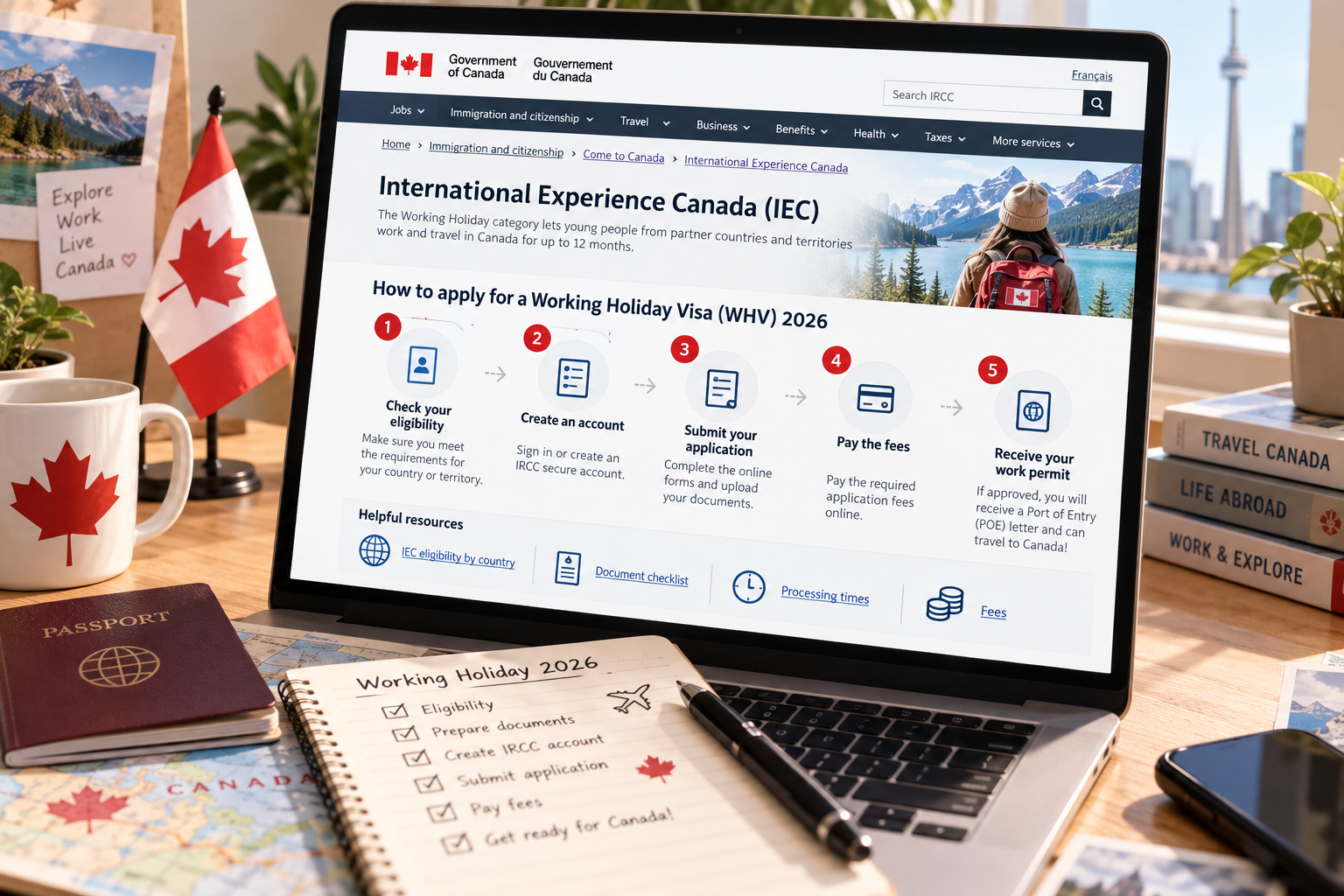
Essential Documents and Fees for Your Application
To avoid processing delays or an outright refusal of your work permit, keeping your documents organized and your fees paid on time is of paramount importance [1.2].
Documents Required for Your IEC Profile
In the very first stage, you do not need to scan or upload heavy documentation [1.8, 1.17]. You only need to have your valid passport on hand to fill out your basic biographical information (such as your full legal name, date of birth, passport number, and expiry date) and confirm your primary contact details [1.2, 1.8].
Documents Required for Your Work Permit Application
Once you are invited to apply (Step 3), you must upload a comprehensive dossier of clear, digital scans [1.2, 1.14]. The table below outlines the core required documents for the work permit phase:
| Document Type | Description & Purpose |
|---|---|
| Valid Passport | A high-quality scan of your passport information page, as well as any pages containing stamps, visas, or markings [1.2]. Your passport must be valid for the entire length of your planned stay in Canada [1.3, 1.6]. |
| Canadian Format Resume/CV | An up-to-date professional CV that outlines your employment history, education, and current city of residence [1.2]. Ensure it adheres to Canadian formatting conventions (omit your birthdate, photo, or marital status) [1.2]. |
| Family Information Form | Typically Form IMM 5707, requiring you to list your parents, siblings, and spouse or common-law partner, regardless of whether they are coming to Canada [1.2]. |
| Police Certificates | Official, clear criminal record checks from your home country, and any country where you have spent 6 months or more consecutively since the age of 18 [1.2]. |
| Digital Photograph | A recent digital photo that meets strict IRCC photo specifications regarding size, plain background, and neutral facial expression [1.2]. |
| Proof of Funds | A recent bank statement (dated within the last few days) showing your available balance is at least CAD $2,500 [1.3]. |
| Proof of Health Insurance | A copy of your comprehensive international travel and medical insurance policy showing coverage for the duration of your stay [1.2, 1.6]. |
Application Fees and How to Pay
All fees are processed digitally through your secure IRCC portal at the time of your work permit application [1.2]. The fees required for a Working Holiday participant for the 2026 season are broken down as follows:
- IEC Participation Fee: CAD $184.75 [1.2]
- Open Work Permit Holder Fee: CAD $100.00 [1.2]
- Biometrics Fee (if required): CAD $85.00 [1.2]
This brings the standard total government processing cost to CAD $369.75 [1.2]. Please note that any costs associated with securing police certificates, completing your panel medical exam, or translating documents into English or French are separate and must be paid directly to the service providers [1.2].
Life and Work in Canada on a Working Holiday Visa
Securing your work permit is the administrative hurdle, but preparing for your day-to-day life in Canada is where the real adventure begins. Navigating a new country can be overwhelming, so we have put together the essential checklist to help you transition smoothly.
Finding Employment in Canada
One of the biggest questions we get from young travelers is: “What kind of jobs can I find?” Because your permit is open, the possibilities are virtually limitless [1.5, 1.8]. However, many Working Holiday makers flock to sectors that accommodate seasonal schedules and offer high flexibility, such as:
- Tourism & Hospitality: Cafe baristas, bartenders, hotel front desk agents, tour guides, and ski resort operators (lift attendants, rental technicians) [1.2].
- Retail & Customer Service: Sales associates, store merchandisers, and administrative assistants [1.2].
- Seasonal Agriculture & Construction: Fruit picking in the Okanagan Valley, landscaping, or entry-level trades [1.2].
To secure a job, your resume should be tailored to Canadian standards [1.2]. Focus on clear, concise descriptions of your duties, emphasize transferrable customer-service or technical skills, and leave out personal details like your height, age, or a profile picture, which are standard in some European or Asian CVs [1.2]. High-quality resources for job searching include Indeed Canada, LinkedIn, and Job Bank Canada (the official government job board) [1.2]. For seasonal positions in mountain and beach towns, reaching out directly to businesses or checking local community boards is often incredibly effective [1.2].
Accommodation and Living Expenses
Canada is a massive country, and living costs vary drastically between provinces. High-demand urban centers like Vancouver and Toronto feature some of the highest rental prices in North America [1.2]. Conversely, mid-sized cities like Calgary, Edmonton, or Halifax, as well as smaller resort towns, offer a more accessible cost of living [1.2].
Most Working Holiday travelers book a hostel or a short-term Airbnb for their first two weeks [1.2]. Once on the ground, they look for shared housing or room rentals to keep costs manageable [1.2]. Popular local classified websites like Kijiji and Facebook Marketplace are primary hubs for finding roommates or sublets [1.2]. An expert tip: Never transfer rental deposits or sign a lease before viewing a property in person, as rental scams targeting newcomers are unfortunately common [1.2].
Banking, Taxes, and Essential Services
To work and live smoothly, there are three administrative steps you must take within your first week of arriving in Canada:
- Get Your Social Insurance Number (SIN): You cannot legally work or pay taxes in Canada without a SIN [1.2]. You can apply for one for free at any Service Canada office, and they will print your nine-digit number on the spot if you bring your physical work permit and passport [1.2].
- Open a Canadian Bank Account: Many major Canadian banks (such as RBC, TD, Scotiabank, and CIBC) offer specialized, fee-free “newcomer packages” for your first year [1.2]. Opening an account requires your passport, work permit, and a Canadian proof of address (or temporary hostel address) [1.2].
- File Your Taxes: As a Working Holiday visa holder, you are subject to Canadian income tax laws [1.2]. Your employer will deduct taxes from each paycheck, and you will receive a T4 slip (summary of earnings) at the end of the tax year [1.2]. You should file a tax return in the spring, which often results in a tax refund for seasonal travelers [1.2].
Health and Safety Considerations
Canada is widely recognized as one of the safest countries in the world. However, its wilderness can be extreme [1.2]. If you are exploring the backcountry, hiking, or skiing, always research the regional safety guidelines regarding wildlife (such as bears) and weather precautions [1.2]. Ensure you have saved 911—the single nationwide emergency phone number for police, fire, and ambulance services [1.2]. Finally, remember that your travel health insurance policy is your ultimate safety net; keep your policy details saved on your phone and easily shareable with friends or travel partners [1.2].
Making the Most of Your Canadian Experience
Your working holiday is about more than just earning money; it is about immersing yourself in the Canadian way of life [1.2]. Make it a priority to experience local cultural traditions [1.2]. Go to a live ice hockey game, try authentic poutine, attend summer music festivals, and hike in the legendary National Parks [1.2]. Joining local expat groups, volunteering for community events, or trying new outdoor sports are excellent ways to build a warm community of friends from around the world [1.2].
Frequently Asked Questions
How long can I stay in Canada on a Working Holiday Visa?
The duration of your stay depends on your country of citizenship [1.8]. Some countries, like the United Kingdom, France, Ireland, and Australia, have agreements that allow for up to 24 months [1.8]. Other countries have agreements limited to 12 months [1.8]. Your work permit will be issued to match the duration set out in your country’s specific bilateral agreement, provided your passport and travel insurance are valid for that entire period [1.3, 1.6].
Can I extend my Working Holiday Visa in Canada?
Generally, no. The IEC Working Holiday is a one-time opportunity per person [1.5, 1.14]. You cannot extend your permit beyond the maximum time frame allocated to your country under the program [1.8]. However, if you wish to stay in Canada longer, you may explore changing your status to a visitor record, or transitioning to a different stream of work permit or study permit before your current visa expires [1.2].
Do I need a job offer before arriving in Canada on a WHV?
No, you do not need a job offer [1.8]. The Working Holiday stream provides an open work permit, giving you the flexibility to travel first and search for work after you land [1.8]. If you do want to secure a job ahead of time, you are welcome to apply online before departing, but it is not a requirement to enter the country or activate your permit [1.3, 1.8].
What happens if my health insurance expires during my stay?
It is illegal to be in Canada on an IEC work permit without valid health insurance [1.2, 1.6]. If your insurance expires, your work permit becomes invalid, and you run the risk of facing significant financial liability if you experience a medical emergency [1.2]. Always ensure your insurance policy is active for your entire stay [1.3, 1.6].
Is there an age limit for the Canada Working Holiday Visa?
Yes. The general age limit is 18 to 35 (inclusive) at the time you submit your work permit application [1.5, 1.11]. However, depending on your country of citizenship, the upper age limit may be 30 years old [1.5, 1.6]. Always verify your country’s specific agreement before starting your application [1.6].
Conclusion
The Canada Working Holiday Visa is a gatekeeper to a life-changing adventure, offering you the unique freedom to explore a vibrant, welcoming country while gaining valuable international work experience [1.5, 1.8]. Whether your goal is to add global weight to your resume, conquer the snowiest peaks of the Rocky Mountains, or build friendships that span continents, the IEC program makes it all possible [1.5, 1.8].
The secret to a successful working holiday lies in careful planning [1.3]. By thoroughly understanding the eligibility requirements, preparing your documents in advance, and systematically following the step-by-step application process, you can navigate the 2026 season with ease and minimize the stress of relocation [1.5, 1.13, 1.14]. When you are ready to make the leap, we are here to support you at every turn. Start by checking your country’s pool status, compile your documents, and take the first exciting step toward your Canadian journey today!
