
Navigating the intricacies of international travel and immigration can be a daunting task, especially when it involves Canada. For many individuals worldwide, a Canada visitor visa, officially known as a Temporary Resident Visa (TRV), is an essential document required to enter the country for purposes such as tourism, visiting family, or attending business meetings.
As we move into 2026, Immigration, Refugees and Citizenship Canada (IRCC) continues to refine its processes, with a strong emphasis on digital applications and meticulous documentation. This comprehensive guide is designed to provide you with a clear, step-by-step roadmap for understanding the requirements, current fees, and the entire application process to help you secure your entry into Canada confidently. Whether you’re planning a short vacation or aiming to visit family who are studying or working in Canada, understanding these details for 2025-2026 is crucial for a smooth application.
Understanding the Canada Visitor Visa (Temporary Resident Visa)
The Temporary Resident Visa (TRV) serves as the primary entry document for non-visa-exempt nationals wishing to visit Canada. It’s an official stamp or sticker placed in your passport by an IRCC officer, indicating that you meet the requirements for a temporary stay. But how do you know if you need a TRV or something else entirely?
Visitor Visa vs. eTA: Which one do you need?
One of the most common points of confusion for prospective visitors is distinguishing between a Temporary Resident Visa (TRV) and an Electronic Travel Authorization (eTA). The fundamental difference lies in your nationality and, to some extent, your mode of travel. Your country of citizenship is the primary factor determining which document you need.
Generally, citizens of certain countries require a TRV to enter Canada, such as those from India, the Philippines, Vietnam, China, and many countries in Africa and South America. These individuals must apply for and obtain a TRV before traveling to Canada. Conversely, citizens of visa-exempt countries, including the United States, most European Union countries, Australia, and the United Kingdom, typically do not need a TRV. However, if they are flying into Canada, they will need an eTA. It’s important to note that an eTA is exclusively for air travel; if a visa-exempt foreign national enters Canada by land or sea (e.g., from the U.S.), an eTA is not required.
A TRV is a physical document—a sticker placed in your passport by a Canadian visa office—that allows you to travel to and seek entry at a Canadian port of entry. An eTA, on the other hand, is digitally linked to your passport and remains valid for up to five years or until your passport expires, whichever comes first. It’s not a physical document you carry. Understanding this distinction is vital to ensure you apply for the correct travel authorization, avoiding delays or even refusal at the border.
| Requirement | Temporary Resident Visa (TRV) | Electronic Travel Authorization (eTA) |
|---|---|---|
| Cost (CAD) | $100 (visa processing) + $85 (biometrics) | $7 |
| Validity | Up to 10 years or passport expiry, allowing multiple entries (final stay duration determined at port of entry) | Up to 5 years or passport expiry, whichever comes first |
| Application Method | Online via IRCC secure account or paper application | Online via IRCC eTA application system |
| Who needs it? | Citizens of visa-required countries (e.g., India, Philippines, Vietnam, China) | Citizens of visa-exempt countries traveling to Canada by air (e.g., UK, Australia, most EU countries, but NOT US citizens) |
TRV (Temporary Resident Visa): An official document affixed to your passport that allows you to travel to Canada for a temporary purpose. It is required for citizens of countries that are not visa-exempt.
eTA (Electronic Travel Authorization): A digital authorization linked to your passport, required for visa-exempt foreign nationals traveling to Canada by air.
Eligibility Requirements for a Canada Visitor Visa in 2026
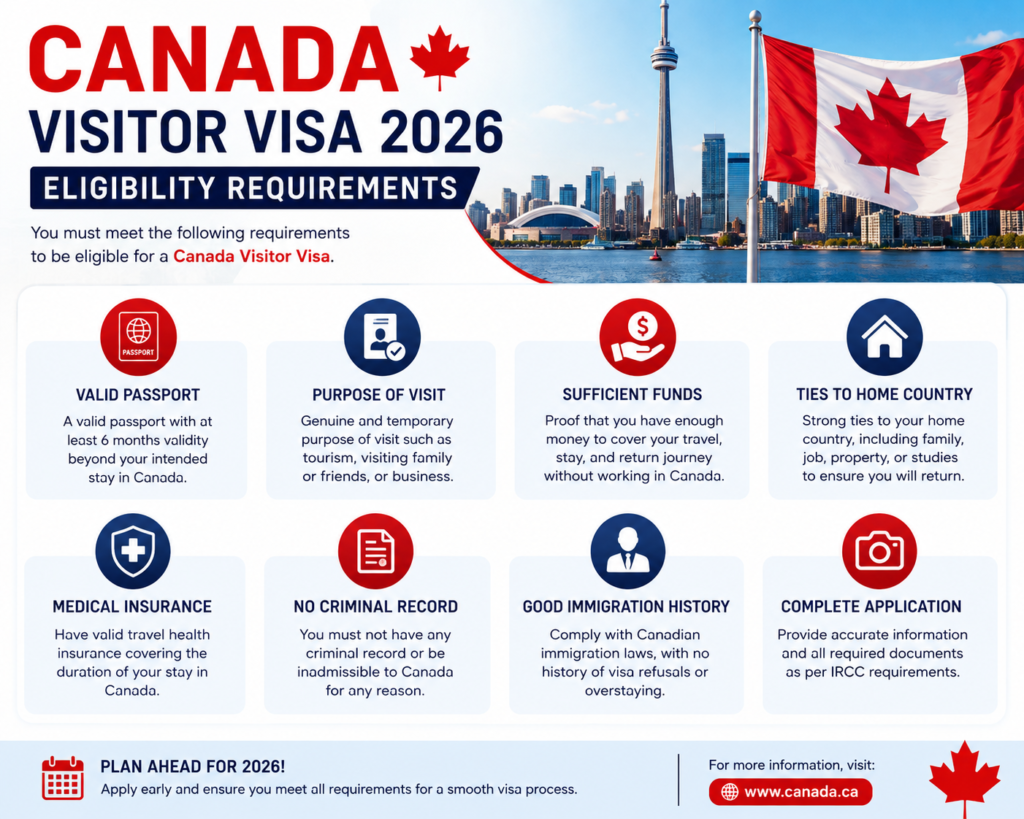
IRCC officers assess each application to ensure visitors genuinely intend a temporary stay and have the means and reasons to return to their home country.
Proving financial support and ties to your home country
Two of the most critical aspects an IRCC officer evaluates are your ability to financially support yourself during your stay in Canada and your strong ties to your home country. These factors are paramount because they directly address the core concern of temporary intent – ensuring you will leave Canada at the end of your authorized visit.
When it comes to Proof of Funds, IRCC needs to see that you have sufficient and accessible money to cover your expenses, including accommodation, food, and transportation, for the duration of your trip. While there isn’t a specific official minimum amount, a general guideline often suggested is around $1,000 to $1,500 CAD per person per week of stay.
However, the exact amount will depend on the length of your visit, your planned activities, and where you intend to stay. More important than just the amount is the liquidity and stability of these funds. Officers are looking for bank statements that show a consistent balance over several months, rather than a large, sudden deposit just before applying. This demonstrates that the funds are genuinely yours and not just a temporary loan. We often advise students’ parents, for instance, to show bank statements from their primary accounts, not just a newly opened savings account.
Equally, if not more, important are your Ties to Home Country. This refers to evidence that demonstrates compelling reasons for you to return to your country of residence after your visit to Canada. Strong ties reassure the visa officer that you are not attempting to overstay your welcome or seek unauthorized permanent residency. This is where your application needs to be very clear and comprehensive.
Evidence of ties can include:
- Employment Letter: A letter from your employer stating your position, salary, start date, and approved leave of absence, with the date you are expected to return to work.
- Property Ownership: Documents like property deeds, land titles, or rental agreements in your home country.
- Family Obligations: Evidence of immediate family (spouse, minor children) remaining in your home country. While visiting family in Canada is a valid reason, showing that you have immediate dependents back home strengthens your case for return.
- Financial Investments: Ownership of businesses, significant investments, or other assets in your home country.
- Academic Enrollment: If you are a student, an enrolment letter from your educational institution showing you are expected to return to continue your studies.
A well-structured “Reason for Travel” statement within your application letter or cover letter is crucial. For example, instead of just saying “I want to visit Canada,” you might explain:
“I am requesting a Temporary Resident Visa to visit my daughter, a Master’s student at the University of Toronto, for a period of three weeks from September 1st to September 21st, 2026, during her fall break.
I have been granted a leave of absence from my role as [Your Job Title] at [Your Company] and am expected to resume work on September 23rd, 2026. My spouse and two minor children will remain in [Home Country] during my visit, and I also own a property there, ensuring my strong ties and intent to return.”
This provides a clear, concise, and compelling narrative.
For those intending to invite family, a strong invitation letter from your host in Canada can significantly support the application. We’ve seen many successful cases where the invitation letter clearly outlines the host’s status in Canada, their financial ability to support the visitor, and the detailed itinerary for the visit.
Documents Required for a Canada Visitor Visa Application
Preparing a complete and accurate set of documents is the cornerstone of a successful visitor visa application. Missing or incorrect documents are frequent causes of delays or refusals. Here’s a definitive checklist for 2026:
Mandatory Documents (Core application requirements):
- Valid Passport: Your passport must be valid for at least six months beyond your intended stay in Canada. It should have at least one blank page for the visa stamp.
- IRCC Application Forms:
- Application for a Temporary Resident Visa (IMM 5257)
- Family Information (IMM 5645)
- Schedule 1 – Application for a Temporary Resident Visa (IMM 5257 – Schedule 1), if applicable.
- Statutory Declaration of Common-law Union (IMM 5409), if applicable.
Ensure all forms are accurately completed, dated, and signed (electronically for online applications).
- Two Recent Passport-sized Photos: These must meet IRCC specifications (e.g., 35mm x 45mm, plain white background, taken within the last six months).
- Proof of Fee Payment: The receipt for your visa application fee and biometrics fee.
- Biometrics Instruction Letter (BIL): You will receive this after submitting your application and paying fees, prompting you to provide biometrics.
Supporting Documents (Strengthen your case):
- Proof of Funds:
- Bank statements (for the last 4-6 months)
- Employment letters, pay stubs
- Property deeds or other assets
- Tax returns (if self-employed)
- Travel Itinerary: A detailed plan of your visit, including flight bookings (not necessarily purchased, but reservations), accommodation details (hotel bookings or invitation letter from host), and places you intend to visit.
- Invitation Letter (if applicable): From a Canadian host, detailing their status in Canada, their relationship to you, purpose of visit, length of stay, and whether they will provide financial or accommodation support. Include their contact information and supporting documents (e.g., Canadian PR card, study permit, work permit, utility bill).
- Ties to Home Country:
- Letter from employer confirming employment, salary, and approved leave.
- Property ownership documents.
- Marriage certificate and birth certificates of dependents not traveling with you.
- Enrolment letter from educational institution (if a student).
- Purpose of Travel Letter (Cover Letter): A personal letter explaining your reason for visiting Canada, your itinerary, and reaffirming your intent to return to your home country. This is your opportunity to address any potential concerns upfront.
- Medical Exam (if applicable): Required if you plan to stay in Canada for more than six months or if you have recently lived in certain designated countries.
- Police Certificates (if requested): May be required based on your travel history or country of residence.
Remember to prepare all documents clearly, ensuring they are legible and translated into English or French by a certified translator, if necessary. It’s often helpful to categorize your documents neatly, making it easier for the visa officer to review your application.
[Insert image: A sample checklist graphic showing ‘Must-have’ vs ‘Support’ documents. The image could be a visual representation of two columns: one with passport, forms, photos, payment, and the other with bank statements, itinerary, invitation letter, employment letter, property deeds.]The Step-by-Step Canada Visitor Visa Application Process
The Canada visitor visa application process is primarily digital for most applicants. Understanding each step can help you avoid common pitfalls and ensure a smoother experience:
- Create an IRCC Secure Account: Your journey begins on the IRCC website. You’ll need to create an account, which can be done via the IRCC Portal or through GCKey. The Portal is the newer, streamlined method, often preferred for its user-friendliness for various application types.
- Complete the Eligibility Questionnaire: Once logged in, you’ll answer a series of questions about your purpose of visit, nationality, and personal circumstances. Based on your answers, the system will determine if you are eligible to apply and generate a personalized document checklist. Be thorough and accurate, as this directly affects the documents you’ll be asked to provide.
- Fill Out Application Forms and Upload Documents: The personalized checklist will guide you on which forms to complete (e.g., IMM 5257, IMM 5645) and what supporting documents to upload. Ensure all forms are filled completely and truthfully. Pay close attention to file size limits and accepted file formats (usually PDF or JPEG) for uploads. I’ve often seen students struggle with document compression, which can lead to frustrating delays if not handled correctly.
- Pay the Fees: After uploading all required documents, you’ll be prompted to pay the application fees online. As of 2026, the standard visitor visa processing fee is $100 CAD, and the biometrics fee is $85 CAD per person. If you’re applying for multiple family members, specific family rates for biometrics might apply.
- Submit Your Application and Wait for the Biometrics Instruction Letter (BIL): Once fees are paid and everything is submitted, you’ll receive a confirmation. Shortly after, if biometrics are required for your application, you will receive a Biometrics Instruction Letter (BIL). This letter is crucial and will tell you where and when to provide your fingerprints and a photo.
- Attend the Biometrics Appointment: With your BIL in hand, you must attend an appointment at the nearest Visa Application Centre (VAC) within 30 days of receiving the letter. This is a mandatory step for most applicants. Ensure you bring your passport and the BIL to the appointment.
- Await a Decision: After biometrics are submitted, all you can do is wait. IRCC will process your application. You can check your application status online via your IRCC secure account. If approved, you will receive a passport request letter, asking you to submit your passport to the VAC for visa stamping. If refused, you will receive a refusal letter explaining the reasons.
VAC (Visa Application Centre): A service provider authorized by IRCC to collect biometrics and handle passport submissions for visa applicants.
BIL (Biometrics Instruction Letter): A letter issued by IRCC instructing an applicant to provide their biometrics (fingerprints and photo) at a designated VAC.
Costs, Processing Times, and Biometrics
Understanding the financial and time commitments involved in a Canada visitor visa application is essential for planning your trip effectively.
Application Fees (as of 2026):
- Visitor Visa (Temporary Resident Visa) processing fee: $100 CAD per person.
- Biometrics fee: $85 CAD per person.
- Family Biometrics fee: A maximum of $170 CAD for a family of 2 or more applying at the same time and place.
These fees are non-refundable, regardless of the outcome of your application. You can pay these fees online through the IRCC secure payment portal using a credit or debit card.
Processing Times:
Processing times for a Canada visitor visa can vary drastically based on the country from which you are applying, the volume of applications, and the completeness of your submission. While some applications might be processed in a few weeks, others can take several months. For example, processing times for applications from India or the Philippines tend to be longer due to high demand. There are no guaranteed processing times, but IRCC aims to process applications as efficiently as possible.
It is crucial to check the most up-to-date processing times directly on the official Canada.ca website. Simply select “Temporary residence” and then “Visitor visa” to see the estimated wait times for your specific country of residence. We always advise clients to apply well in advance of their intended travel date, preferably 3-4 months ahead, to account for any unforeseen delays.
Biometrics:
As mentioned, most visitor visa applicants are required to provide biometrics (fingerprints and a digital photo). This step is mandatory for individuals aged 14 to 79. Once you provide biometrics, they are generally valid for 10 years, meaning you won’t need to provide them again if you apply for another temporary resident visa (visitor visa, study permit, or work permit) within that 10-year period. Your Biometrics Instruction Letter (BIL) will detail where you can provide them, usually at a VAC.
Dual Intent: Visiting Canada While Planning to Immigrate
This is a particularly relevant topic for many of our clients, especially those with family members in Canada on study permits or work permits, or those who have themselves applied for permanent residency. ‘Dual intent’ refers to the situation where a person wishes to enter Canada temporarily as a visitor, but also has the long-term goal of applying for permanent residence. Under Section 22(2) of the Immigration and Refugee Protection Act (IRPA), having dual intent is not, in itself, a reason for inadmissibility.
This means that an individual can legitimately apply for a visitor visa even if they have an active application for permanent residence (PR) in progress, or if they intend to apply for PR while they are in Canada. The key for the visa officer is to be convinced that, despite the long-term goal of permanent residence, the applicant will genuinely respect the terms and conditions of their temporary stay. This includes leaving Canada at the end of their authorized period if their permanent residence application has not been approved by then.
To successfully demonstrate dual intent and secure a visitor visa, applicants must:
- Be Truthful: It is critical to be honest about your intentions. Do not try to hide the fact that you have a PR application in process or hope to immigrate.
- Show Strong Ties to Home Country: As discussed earlier, prove that you have compelling reasons to return to your home country. This demonstrates that you will adhere to your temporary status if your PR application is not finalized.
- Provide a Clear Itinerary: Outline your temporary stay’s purpose and duration.
- Meet All Visitor Visa Requirements: You must satisfy all the standard requirements for a visitor visa (funds, good health, no criminal record, etc.).
For example, if a parent applies for a visitor visa to visit their child who is studying in Canada, and the child plans to sponsor them for PR in the future, the parent can still apply for the visitor visa. Their application should clearly state their intention to visit their child and also acknowledge their long-term immigration aspirations.
The focus should be on demonstrating that they will respect the temporary nature of the visitor visa by returning home if required, and that any PR application is a separate, future consideration. According to IRCC’s own Operational Instructions and Guidelines (OP 11) on Dual Intent, an officer should not refuse a TRV solely because an applicant has dual intent, provided the officer is satisfied that the applicant will leave Canada by the end of the period authorized for their stay.
Common Reasons for Visitor Visa Refusal and How to Avoid Them
Receiving a refusal letter can be disheartening, but understanding the common reasons behind them can help you prepare a stronger application or reapplication. Based on my experience, these are the top reasons for visitor visa refusals:
- 1. Insufficient Funds:Reason: The applicant could not demonstrate enough financial resources to support themselves during their stay in Canada without working illegally or becoming a burden on Canadian social services. Or, the funds shown appeared to be a ‘sudden deposit’ rather than stable savings.
Solution: Provide clear, consistent bank statements (6 months minimum), employment letters with salary details, and any other income sources. If someone in Canada is supporting you, ensure their invitation letter clearly states this and include their financial documents (e.g., Notice of Assessment, bank statements).
- 2. Weak Ties to Home Country (and Strong Ties to Canada):Reason: The visa officer was not convinced that the applicant would leave Canada at the end of their authorized stay. This is often inferred from a lack of significant property, employment, family responsibilities, or other commitments in the home country, combined with close family or other strong connections in Canada.
Solution: Document all your ties: property deeds, a letter from your employer granting leave (with return date), family responsibilities (e.g., spouse and minor children remaining), business ownership. A detailed cover letter explicitly stating your intention to return and outlining your reasons can be very impactful.
- 3. Purpose of Visit Unclear or Not Credible:Reason: The stated reason for visiting Canada was vague, inconsistent, or didn’t seem plausible given the applicant’s circumstances (e.g., claiming tourism but no detailed itinerary, or applying for a visit far exceeding typical vacation lengths without strong justification).
Solution: Provide a detailed itinerary, including flight reservations, accommodation plans, and activities. If visiting family, specify names, relationship, and purpose. If for business, include invitation letters from Canadian companies. Make your visit’s purpose crystal clear and logical.
- 4. Lack of Travel History:Reason: While not an official requirement, a history of international travel (especially to developed countries) and respecting visa terms for those countries can reassure a visa officer of your bona fide intent. A blank passport might raise concerns.
Solution: If you have limited travel history, ensure all other aspects of your application (funds, ties, purpose) are exceptionally strong. A very compelling cover letter explaining your situation and strong reasons for return can help mitigate this.
- 5. Misrepresentation or Incomplete Information:Reason: Providing false information, withholding material facts, or submitting an incomplete application can lead to an outright refusal and a ban from reapplying for several years.
Solution: Be completely honest and thorough in all aspects of your application. Double-check all forms for accuracy. If you made a mistake on a previous application, address it proactively in a new application’s cover letter with a clear explanation.
The importance of a well-crafted ‘Cover Letter’ cannot be overstated. This is your opportunity to address potential concerns before the officer even has them. Use it to narrate your story, explain any complexities (like dual intent or limited travel history), and clearly state your purpose of visit and unwavering intent to return home. It helps bridge gaps that documents alone might not cover, providing context and clarity to your application.
Frequently Asked Questions
How much bank balance is required for a Canada visitor visa?
There is no official minimum bank balance stipulated by IRCC. However, you should demonstrate sufficient funds to cover your stay, typically around $1,000 to $1,500 CAD per week per person. The source and stability of these funds (shown over 4-6 months of bank statements) are more crucial than a sudden large deposit. It needs to be proportional to your planned expenses and duration of stay.
How long can I stay in Canada on a visitor visa?
Upon entry, most visitors are granted a stay of up to six months. However, the exact duration of your authorized stay is determined by the Border Services Officer at the port of entry, who may stamp your passport with a specific date or issue a visitor record. Always check the stamp or document you receive.
Can I work in Canada with a visitor visa?
No, you cannot work in Canada with a visitor visa. A visitor visa is solely for temporary visits such as tourism, family visits, or business meetings. Engaging in unauthorized work is a violation of your visa conditions and can lead to serious consequences, including deportation and future inadmissibility. However, you are permitted to search for jobs and, if you receive a job offer, apply for a work permit from within Canada (subject to specific public policies and eligibility criteria).
Securing a Canada visitor visa for 2026 requires meticulous preparation, a clear understanding of IRCC’s requirements, and diligent documentation. While the process is rigorous, success hinges on proving your genuine intent to visit temporarily and demonstrating strong ties to your home country. We always encourage applicants to begin their application process early, especially given the varying processing times that can occur throughout the year. Before submitting your application, take the time to double-check all documents against the latest IRCC updates. With careful planning and a thorough approach, you can significantly enhance your chances of a positive outcome and look forward to your visit to Canada.
Ready to Apply for Your Canada Visitor Visa?
A strong visitor visa application starts with the right preparation. From reviewing your documents and proof of funds to presenting a clear purpose of travel, every detail matters.
Not sure if your application is ready? Contact Yes Study today for personalized guidance and professional support throughout your Canada Visitor Visa application process. Start preparing early and make your application count.

Pingback: Canada Super Visa 2026: Complete Guide for Parents