
Planning a trip to Canada in 2026, whether for tourism, study, or to start a new life? One of the most critical aspects you absolutely cannot overlook is securing appropriate Travel Insurance to Visit Canada. Canada’s world-renowned healthcare system, while excellent, is not free for non-residents. An unexpected medical emergency, even a minor one like a broken bone or a sudden illness, can quickly lead to hospital bills soaring into the thousands, or even tens of thousands, of CAD dollars.
This comprehensive guide is designed to empower you with all the essential information needed to navigate the complexities of Travel Insurance to Visit Canada in 2026. We’ll delve into what travel insurance entails, who specifically needs it – from tourists and international students to Super Visa applicants and new immigrants and clarify whether it’s mandatory for your specific situation.
Understanding Travel Insurance to Visit Canada
When you’re preparing for a visit, study, or relocation to Canada, understanding the role of travel insurance is foundational. It’s more than just a formality; it’s your financial safety net against the unexpected in a foreign country.
What is Travel Insurance to Visit Canada?
In the context of Canada, travel insurance is a specialized type of insurance coverage designed to protect non-residents from financial losses arising from unforeseen events during their stay. Primarily, it covers emergency medical expenses for sudden illness or injury, which are not covered by Canada’s public healthcare system for temporary visitors. Beyond medical incidents, it can also offer protection against non-medical risks such as trip cancellation or interruption, lost or damaged baggage, and even accidental death or dismemberment. Essentially, it’s a policy that helps mitigate the financial risks associated with traveling outside your home country.
Why Travel Insurance to Visit Canada is crucial for visiting Canada?
The importance of travel insurance for Canada cannot be overstated. Unlike some countries where emergency care might be provided at little to no cost, Canada’s healthcare system operates differently for non-residents. If you’re not a Canadian citizen or permanent resident, or if you don’t qualify for provincial healthcare coverage, you are personally responsible for 100% of your medical bills. This can lead to staggering costs:
- An emergency room visit for a simple ailment could cost upwards of $800-$1,500 CAD.
- A short hospital stay for a few days could easily run you $3,000-$5,000 CAD per day.
- Major surgeries or complex treatments could cost tens of thousands, or even hundreds of thousands, of dollars.
Who needs travel insurance when visiting Canada?
While the degree of necessity varies, the short answer is: almost everyone who is not a Canadian citizen or permanent resident should secure travel insurance when visiting Canada. It’s a vital consideration for various categories of visitors, each with specific needs:
Tourists and general visitors
For individuals visiting Canada on a Temporary Resident Visa (TRV) or from visa-exempt countries, travel insurance isn’t a legal entry requirement. However, we at Yes Study strongly advise every tourist to obtain comprehensive coverage. Whether you’re exploring urban centres, hitting the ski slopes, or simply visiting family, the risk of an unexpected accident or illness is always present. A sudden appendicitis or an unfortunate fall could lead to immense medical bills. Having visitor health insurance Canada ensures that you can enjoy your trip without the constant worry of potential financial disaster from unforeseen health events.
International students
The insurance landscape for international students in Canada can be quite varied. Provincial health coverage for international students differs significantly by province in 2026. For example, provinces like British Columbia and Alberta have programs that include international students after a waiting period, while others like Ontario and Quebec have more limited or no direct provincial health coverage for all students. Most educational institutions, regardless of provincial plans, mandate that students have comprehensive health insurance as a condition of enrolment. This often means purchasing a private plan, especially to cover periods before provincial plans kick in, during study breaks, or for services not covered by provincial plans.
Always check with your specific university or college’s international student office and the respective provincial health ministry website to understand your exact requirements for 2026.
Super Visa applicants and holders
For parents and grandparents of Canadian citizens or permanent residents applying for a Super Visa, comprehensive medical insurance from a Canadian insurance company is not just recommended, it is a mandatory requirement. As of 2026, Immigration, Refugees and Citizenship Canada (IRCC) explicitly states that applicants must provide proof of private medical insurance:
- With a minimum coverage of $100,000 CAD.
- Valid for at least one year from the date of entry into Canada.
- From a Canadian insurance company.
- Paid in full or with proof of a one-year payment plan.
Failure to meet these stringent requirements will result in your Super Visa application being denied or refusal of entry into Canada.
New immigrants awaiting provincial health coverage
Most Canadian provinces have a waiting period before new permanent residents become eligible for provincial health coverage. As of 2026, this waiting period can typically range from 2 to 3 months in provinces such as Ontario, British Columbia, and Quebec. During this interim period, you and your family are responsible for any medical costs incurred. This is where “bridge insurance” or “new immigrant insurance” becomes invaluable. It covers this gap, ensuring that a medical emergency shortly after your arrival doesn’t result in significant, unexpected medical bills while you await your provincial health card. This is a practical necessity to protect your finances during a crucial transitional phase.
Is Travel Insurance Mandatory for Canada?
The question of whether travel insurance is mandatory for Canada is nuanced, depending entirely on your visitor status. It’s not a one-size-fits-all answer, but understanding the specific requirements for your situation is paramount.
For general visitor visas (TRV)
For most tourists and general visitors entering Canada on a Temporary Resident Visa (TRV) or as visa-exempt travellers, travel insurance is not legally mandatory for entry. This means you won’t be denied entry simply because you don’t have a policy. However, as an expert in this field, I cannot stress enough that forgoing insurance is an incredibly high-risk gamble. The financial implications of an unexpected medical emergency can be catastrophic. While not required by law, it is unequivocally a critical recommendation for personal financial protection against Canada’s high healthcare costs.
For Super Visa applicants
For Super Visa applicants, the answer is a resounding – Yes, it is mandatory!
As reiterated, IRCC guidelines for 2026 clearly state that comprehensive medical insurance from a Canadian company, with a minimum coverage of $100,000 CAD, valid for at least one year from your entry date, and paid in full, is an absolute prerequisite. Without proof of this specific Super Visa insurance Canada, your application will be refused. There are no exceptions to this rule.
For international students
For international students, the mandatory nature of health insurance varies. There is no overarching federal mandate. Instead, requirements are typically set at the provincial level or by the educational institution itself. For example:
- British Columbia and Alberta: International students are generally required to enroll in the provincial health plan (MSP in BC, AHCIP in Alberta) after a waiting period, and often need private insurance to bridge this gap or cover services not included.
- Manitoba: International students are eligible for the provincial health plan (Manitoba Health) upon arrival.
- Ontario and Quebec: Many international students in Ontario and Quebec rely on university-mandated health plans or private insurance, as direct eligibility for provincial plans can be limited or subject to specific conditions.
Therefore, it is crucial for students to verify requirements with both their provincial health ministry website and their specific university or college’s international student office for 2026. Often, if provincial coverage is available, it might have waiting periods, or might not cover all services, making supplementary private international student insurance Canada essential.
For new permanent residents
While not a direct immigration requirement, obtaining private “bridge insurance” is a practical mandatory necessity for new permanent residents during the provincial health plan waiting period. As of 2026, provinces such as Ontario, British Columbia, and Quebec typically impose a waiting period of up to 3 months before new PRs become eligible for their provincial health coverage. During this period, any medical emergencies or treatments would be 100% out-of-pocket, potentially leading to substantial debt. To avoid this catastrophic financial burden, securing private insurance to cover this gap is critically important.
Types of Travel Insurance Coverage for Canada
Travel insurance policies are not all identical. Understanding the different types of coverage available helps you tailor a plan that truly meets your needs for visiting Canada.
Emergency medical insurance
Emergency medical insurance is designed to cover unexpected illnesses or injuries that occur during your trip. It steps in when you face a medical crisis that requires immediate attention and wouldn’t be covered by Canada’s public healthcare system. What it typically covers includes:
- Doctor’s visits and consultations: For sudden, unexpected ailments.
- Hospital stays: Including ward accommodation, nursing care, and hospital services.
- Diagnostic tests: Such as X-rays, MRI scans, and laboratory tests.
- Prescription medication: For emergency medical conditions.
- Ambulance services: Ground or air ambulance when medically necessary.
- Emergency dental care: For accidental injury to natural teeth.
- Emergency medical evacuation: Transportation to the nearest appropriate medical facility, or even repatriation back to your home country if medically necessary.
When we work with students and visitors, our team always emphasize that while other coverages are beneficial, this one is non-negotiable given the exorbitant costs of medical care in Canada.
Trip interruption and cancellation insurance
This type of coverage protects your non-refundable travel expenses should your trip be unexpectedly cancelled or interrupted due to a covered reason. Trip cancellation insurance applies before your departure, reimbursing you for pre-paid, non-refundable expenses like flights, accommodations, and tour packages if you have to cancel due to unforeseen circumstances.
Trip interruption insurance, on the other hand, kicks in after your trip has already begun, covering additional costs incurred or lost expenses if you have to cut your trip short for a covered reason.
For instance, if a close family member falls gravely ill back home, forcing you to return early, this coverage would help recover the unused portion of your trip and possibly the cost of an emergency flight home.
Baggage and personal effects insurance
This coverage provides financial compensation if your luggage and personal items are lost, stolen, damaged, or even delayed during transit. While no one expects their bags to go missing, airline mishaps or unforeseen theft can happen.
This policy can cover the depreciated value of your belongings up to a certain limit. It’s important to note common exclusions, such as very high-value electronics, cash, or items lost due to your own negligence.
If you need to make a claim, typically you’ll need to provide evidence like airline delay reports, baggage tags, or police reports for theft.
Accidental Death and Dismemberment (AD&D)
Accidental Death and Dismemberment (AD&D) insurance provides a payout to your designated beneficiaries if you tragically die due to an accident during your trip. It also offers compensation if you lose a limb or your sight as a direct result of an accident. While certainly not the primary reason to purchase travel insurance, it’s a common add-on or standard inclusion in many comprehensive plans, offering an additional layer of financial protection for your loved ones in the face of an unforeseen tragedy. Policies typically have specific conditions regarding the nature of the accident and predefined payout limits for different types of losses.
Multi-trip vs. single-trip plans
When selecting your travel insurance, you’ll typically encounter two main types of plans based on your travel frequency:
| Feature | Single-Trip Plan | Multi-Trip Plan (Annual Plan) |
|---|---|---|
| Coverage Period | Covers one specific journey for a defined, continuous period (e.g., 30 days, 6 months). | Covers multiple trips within a 12-month period, with each trip typically limited to a certain duration (e.g., 15, 30, 60 days per trip). |
| Cost Structure | Priced based on the specific duration of that single trip. | A single annual premium that covers all eligible trips within the year. |
| Ideal for | Individuals planning a single, longer stay in Canada (e.g., a multi-month tourist visit, a Super Visa stay) or infrequent travellers. | Frequent visitors to Canada or individuals making several short trips within a year (e.g., business travellers, cross-border family visits). |
| Flexibility | Less flexible for spontaneous or numerous trips; requires purchasing a new policy for each trip. | Highly convenient and often more economical for frequent travelers, as you don’t need to re-purchase each time. |
For someone planning an extended stay like a Super Visa holder, a single-trip plan covering the full year is usually the most straightforward choice. If you anticipate multiple short visits throughout the year, a multi-trip plan could offer better value.
Key Factors to Consider When Choosing a Travel Insurance Plan
Selecting the right travel insurance plan for Canada requires careful consideration beyond just the premium price. Understanding these key factors will help you choose a policy that truly protects you.

Coverage amount and limits
This is arguably the most critical decision for emergency medical coverage. For general visitors, we typically recommend a minimum emergency medical coverage of $100,000 CAD, but ideally, you should aim for $250,000 CAD or even higher. While $100,000 CAD might seem like a lot, given the potential costs of serious medical incidents in Canada, it can be exhausted surprisingly quickly. Higher limits offer significantly greater protection and peace of mind.
For Super Visa applicants, remember that $100,000 CAD is the mandatory minimum coverage required by IRCC for 2026. When reviewing policies, understand both the aggregate limit (the total maximum amount the insurer will pay out over the policy period) and any per-incident limits, which cap payouts for individual medical events.
Deductibles and co-insurance
A deductible is the amount you pay out of pocket before your insurance covers eligible expenses; for instance, with a $500 deductible and $2,000 in medical bills, you pay $500, and the insurer covers the rest. Higher deductibles typically lead to lower premiums, but require more upfront payment when claiming. Co-insurance, less common in visitor medical plans, refers to the percentage of costs you share with the insurer after the deductible is met. It’s essential to choose a deductible that balances premium savings with potential out-of-pocket costs.
Pre-existing medical conditions
This is a major point of concern for many travelers, especially older visitors or those with known health issues. A pre-existing medical condition is generally defined as any illness, injury, or medical condition for which you have received diagnosis, medical advice, or treatment, or for which symptoms were present, prior to your policy’s effective date. Many standard travel insurance policies will exclude coverage for pre-existing conditions unless specific criteria are met.
The most common criterion is a “stability period” – meaning the condition must have been stable (no new symptoms, diagnosis, or change in medication) for a defined period (e.g., 90, 120, or 180 days) immediately preceding your effective date of coverage. It is absolutely crucial to be honest and transparent about your health history when applying, as non-disclosure could void your policy. Some insurers offer specialized plans or riders to cover stable pre-existing conditions, often at a higher premium. Always clarify the definition of “stability period” and ensure your condition meets the criteria with your chosen provider for 2026.
Policy duration and extension options
It is paramount to purchase insurance that covers the entire duration of your planned stay in Canada. For Super Visa holders, this means at least one full year from your anticipated entry date. Letting your coverage lapse, even for a single day, can leave you completely vulnerable. Life happens, and sometimes travel plans change. Most reputable insurers offer options to extend your coverage if your stay in Canada is prolonged. However, it’s vital to initiate the extension process before your current policy expires. Extensions often involve a new application, potentially new underwriting (review of your health), and new waiting periods for new illnesses. Plan ahead to ensure continuous protection.
Waiting periods
A waiting period is a specified length of time, typically after you purchase a policy, during which certain benefits are not yet active. These are particularly common if you purchase insurance after you have already arrived in Canada. For instance, some policies might have a 48-hour or 72-hour waiting period for new illnesses if bought post-arrival. This is to prevent individuals from buying insurance only when they are already sick or know they need medical attention. Accidental injuries, however, are usually covered immediately. Always read the policy details carefully to understand any applicable waiting periods and factor this into your purchasing decision, ideally buying before you arrive to minimize any gaps.
Repatriation and medical evacuation
These two often-overlooked components are incredibly important for comprehensive coverage. Medical evacuation covers the immense costs of transporting you to the nearest suitable medical facility if you become critically ill or injured, or even back to your home country if local care is insufficient. This can involve specialized air ambulances and medical escorts, easily costing tens of thousands of dollars.
Repatriation of remains covers the expenses of returning your body to your home country in the unfortunate event of your death. These costs are rarely, if ever, covered by basic provincial plans or standard emergency medical policies alone, making them essential additions for international visitors. I always advise my clients to look for plans that include robust repatriation and evacuation benefits for complete peace of mind.
Understanding the Cost of Travel Insurance for Canada
The cost of travel insurance for Canada, or your premium, isn’t a fixed amount. It’s influenced by several variables that insurers use to assess the level of risk they are taking on. Understanding these factors can help you anticipate costs and choose wisely.
Factors influencing insurance premiums
Age of applicant
Age is one of the most significant determinants of your insurance premium. Generally, premiums tend to increase incrementally with age, and you’ll often see sharper increases for applicants over 60 or 70. This is because older individuals are statistically more likely to experience health complications or require medical attention, representing a higher risk for the insurance provider.
Health status and pre-existing conditions
Your current health and medical history play a critical role. If you have pre-existing medical conditions, especially those that are not well-controlled or have required recent treatment, your premiums will likely be higher. Some conditions might even require specialized, more expensive policies. Honest disclosure of your health status is crucial to ensure your policy remains valid should you need to make a claim.
Length of stay
The longer you plan to stay in Canada, the higher your total insurance premium will be. Insurance is generally priced on a per-day or block-of-days basis. A longer duration simply means an extended period of risk for the insurer, thus increasing the overall cost. A one-year Super Visa policy will naturally cost more than a two-week tourist policy.
Desired coverage amount
The maximum amount of coverage you choose directly impacts your premium. A policy offering $250,000 CAD in emergency medical coverage will cost more than an identical policy offering $100,000 CAD. While a higher limit means a higher premium, it also provides greater protection against potentially crippling medical bills.
Deductible choice
As discussed, the deductible is the amount you pay first. There’s an inverse relationship here: choosing a higher deductible (e.g., $1,000 CAD) will typically result in a lower premium, while a lower deductible (e.g., $0 or $250 CAD) will lead to a higher premium. You need to weigh the savings on your premium against the amount you’re prepared to pay out-of-pocket in an emergency.
Plan type (e.g., basic vs. comprehensive)
A basic emergency medical-only plan will naturally be less expensive than a comprehensive plan that includes additional benefits like trip cancellation/interruption, baggage insurance, and accidental death and dismemberment. Consider the value and peace of mind these additional coverages offer versus the increased premium when making your decision.
| Factor | Description | Impact on Premium |
|---|---|---|
| Age | Applicant’s age at the time of purchase. | Generally, higher age = higher premium. |
| Health Status & Pre-existing Conditions | Medical history, current health, and stability of existing conditions. | Poorer health/unstable conditions = higher premium or specialized plan. |
| Length of Stay | Total duration of the trip in Canada. | Longer stay = higher overall premium. |
| Coverage Amount | Maximum payout limit for emergency medical benefits. | Higher coverage limit = higher premium. |
| Deductible Choice | Amount paid out-of-pocket before insurance covers costs. | Higher deductible = lower premium; Lower deductible = higher premium. |
| Plan Type | Scope of benefits included (e.g., medical-only vs. comprehensive with trip, baggage). | Comprehensive plans = higher premium; Basic plans = lower premium. |
When and How to Purchase Travel Insurance for Canada
The timing and method of purchasing your travel insurance to visit Canada are just as important as the policy details themselves. Proactive planning can save you significant stress and ensure immediate coverage.
Buying before or after arrival in Canada
My strongest recommendation, based on years of experience, is to always purchase your travel insurance before departing for Canada. This offers several critical advantages:
- Immediate Coverage: Your policy can be effective the moment you land in Canada, ensuring you’re protected from the very first minute.
- No Waiting Periods: For new illnesses or accidents, buying before arrival usually means no waiting periods, unlike policies purchased once you’re already in Canada, which often impose a 48-72 hour (or longer) waiting period for new illnesses. Imagine landing, falling ill, and realizing your newly purchased policy won’t cover you for two more days!
- More Options & Better Rates: You generally have a wider selection of policies and often more competitive rates when purchasing from your home country or an international provider before you travel.
- Super Visa Requirement: For Super Visa applicants, purchasing before application (and certainly before arrival) is mandatory. Proof of insurance is required as part of the visa application process.
While it is possible to buy insurance after arriving in Canada, this comes with significant risks. Fewer providers may offer coverage, rates might be higher, and almost all will impose a waiting period for new illnesses, leaving you vulnerable during that initial period. It’s simply not worth the gamble.
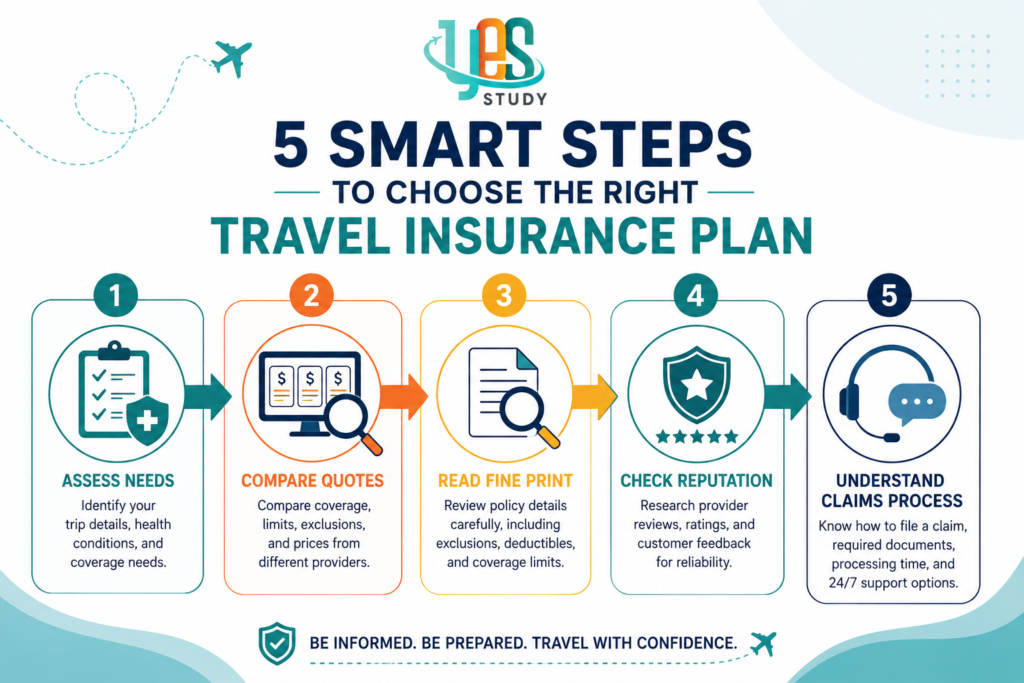
Steps to compare and choose a policy
Choosing the right travel insurance doesn’t have to be overwhelming if you follow a structured approach.
What documents do you need?
Having your documents in order is essential both for purchasing insurance and for making a claim:
- For Purchasing a Policy:
- Your passport details (name, date of birth, passport number).
- Your home country address.
- Your intended travel dates to and from Canada.
- Detailed medical history (if you have pre-existing conditions, be prepared to provide dates of diagnosis, treatment, and medication).
- Proof of eligibility (e.g., letter of acceptance for international students, invitation letter for Super Visa).
- For Making a Claim:
- Your policy number and contact information for the insurance company.
- Original medical reports from doctors or hospitals.
- Itemized invoices and receipts for all medical expenses incurred.
- Police reports (for theft or accidents involving law enforcement).
- Airline documents (for lost baggage, flight delays, or cancellations).
- Any correspondence with other parties involved (e.g., airline, hotel).
- Proof of payment for services rendered.
What Happens If You Don’t Have Travel Insurance in Canada?
While the allure of saving money by skipping travel insurance might be tempting for some, the potential consequences of not having adequate coverage in Canada can be severe, far outweighing any perceived savings. It’s a risk that I, as an expert, strongly advise against taking.
Financial risks and high
This is the most immediate and devastating consequence. Canada’s healthcare system is not free for non-residents. If you experience a medical emergency without insurance, you are 100% responsible for all costs. Let’s look at some illustrative examples for 2026:
- An emergency room visit for a non-life-threatening issue: $800 – $1,500+ CAD
- A short hospital stay (2-3 days) for a common illness like pneumonia: $3,000 – $5,000+ CAD per day, potentially total of $9,000 – $15,000+ CAD
- A broken leg requiring surgery, hospital stay, and rehabilitation: $10,000 – $50,000+ CAD
- A severe medical event like a heart attack or stroke requiring intensive care and complex procedures: $100,000 – $500,000+ CAD
These are not exaggerated figures; they are real costs faced by uninsured visitors. These bills can quickly deplete your savings, force your family to take on immense debt, or even lead to bankruptcy. We’ve unfortunately seen instances where families had to start crowdfunding campaigns to cover unexpected medical bills, leading to immense stress during an already difficult time.
Visa implications (especially for Super Visa)
For Super Visa applicants, the lack of valid medical insurance from a Canadian company is an automatic red flag and grounds for visa refusal. IRCC is unequivocal on this point. Even for general visitors, while not a direct requirement for a TRV, immigration officers at the port of entry may inquire about your financial means to support yourself and cover unexpected costs during your stay. If they perceive you as potentially becoming a burden on the Canadian healthcare system due to a lack of insurance, they could have grounds to refuse your entry, even if you have a valid visa.
Impact on family and travel plans
Beyond the financial and immigration consequences, not having travel insurance can create an emotional and logistical nightmare. If you fall seriously ill or get injured, your family members might have to drop everything, travel to Canada on short notice, and deal with coordinating your care, navigating a foreign healthcare system, and managing the financial strain. This immense stress can completely overshadow the purpose of your visit, turning what was meant to be a joyous occasion into a period of extreme anxiety and burden for everyone involved. Your travel plans, and potentially those of your family, would be severely disrupted, often with long-lasting negative impacts.
Frequently Asked Questions
Is travel insurance mandatory for all visitors to Canada?
No, it’s not universally mandatory. It is legally required for Super Visa applicants. For international students, it’s often mandated by their educational institutions or provincial health plans. For other visitors on a Temporary Resident Visa (TRV), it’s not legally mandatory but is very strongly recommended due to Canada’s high medical costs for non-residents.
What is the recommended coverage amount for visitors to Canada?
For emergency medical coverage, the general recommendation is between $100,000 CAD and $250,000 CAD. For Super Visa applicants, a minimum of $100,000 CAD from a Canadian insurance company is mandatory for 2026. Opting for higher coverage offers better financial protection against potentially extensive medical bills.
Can I extend my travel insurance while already in Canada?
Yes, often it’s possible to extend your travel insurance, but it depends on your specific policy and provider. Most insurers require you to apply for an extension before your current policy expires. Be aware that extensions might involve a new underwriting process, potentially different rates, or new waiting periods for illnesses contracted after the extension takes effect.
Does travel insurance for Canada cover pre-existing medical conditions?
Coverage for pre-existing medical conditions varies widely by policy. Many standard plans exclude them unless the condition has been “stable” for a specific period (e.g., 90-180 days) immediately prior to the policy’s effective date, meaning no changes in diagnosis, medication, or treatment. Some specialized plans offer coverage for stable or even unstable conditions, often at a higher premium or with a specific rider. Always declare your conditions honestly and verify the policy’s terms.
What documents do I need to make a claim?
To make a claim, you’ll typically need your policy number, original medical reports (from doctors/hospitals), itemized invoices and receipts for all expenses, and possibly police reports (for theft/accidents). For trip-related claims, flight details or hotel booking confirmations are often required. Keep all documentation organized and submit them within the insurer’s specified timeframe.
