
Planning your journey to Canada, whether for study, work, or permanent residency, involves numerous critical steps. These timelines, provided by Immigration, Refugees and Citizenship Canada (IRCC), are dynamic estimates that reflect the period from when your application is submitted to when a final decision is made. They vary significantly based on the type of application, your country of origin, and the current volume of demand, making continuous monitoring essential for all prospective immigrants and students.
At Yes Study, we consistently emphasize that the official IRCC website is the most authoritative source for the latest updates. When we talk about “IRCC processing times”, we’re referring to the estimated duration it takes for Immigration, Refugees and Citizenship Canada to process a complete application, calculated from historical data. It’s crucial to remember that these are not guarantees but rather estimates, subject to change. This guide aims to provide you with the most current information for 2026, helping you navigate the complexities and plan your Canadian aspirations with greater confidence.

What are Canada visa processing times and how are they calculated?
Understanding what Canada visa processing times truly represent and the factors that influence them is the first step toward a successful application. These aren’t arbitrary numbers but rather a reflection of IRCC’s operational realities.
Defining IRCC processing times and their significance
IRCC processing times are estimates based on the average time it took to process 80% of complete applications in a recent period, often over the last 6-12 weeks. The clock starts the day IRCC receives a complete application and stops when a final decision is made. It’s vital to grasp that these are historical averages, not a promise for your specific application. While 80% of applications might be processed within, say, six months, 20% will take longer. For example, if the listed time for a study permit is 10-15 weeks, it means 80% of similar applications were processed within that timeframe, but your individual application could be processed faster or slower.
For applicants, this information is profoundly significant. It enables you to plan your finances, logistics, and even emotional readiness for a move or extended stay in Canada. Knowing the estimated wait helps you decide when to book flights, arrange accommodation, and manage your employment or academic start dates. This foresight can significantly reduce anxiety and help prevent costly last-minute changes.
Key factors influencing processing times for all applications
Several dynamic factors can influence how quickly any Canada visa or permit application is processed. Understanding these can help you mitigate potential delays:
- Application completeness and accuracy: This is arguably the most critical factor. Incomplete applications, or those with errors, are often returned, which means the processing clock resets, or they are significantly delayed while IRCC requests additional information.
- Volume of applications: High demand for specific programs or from particular countries can create backlogs, extending processing times.
- Complexity of the application: Issues such as criminal records, security concerns, or complex family situations require more extensive background checks and can lead to longer processing.
- Country of applicant: Different visa offices around the world have varying workloads and processing capacities. For instance, high-volume regions like India and Nigeria often experience longer processing times for visitor visas compared to other countries.
- Biometric and medical examination requirements: Processing stops until IRCC receives your biometrics and medical exam results. Delays in completing these steps or receiving results from third-party panel physicians can halt your application.
- IRCC operational capacity: Internal factors such as staffing levels, technological infrastructure, and policy changes within IRCC can impact processing speeds.
For example, if you forget to include a police certificate from a country where you lived for more than six months, IRCC will likely return your application or request it later, adding months to your processing time. When working with students, I’ve often seen how quickly an application can be returned due to a simple oversight like an unsigned form or missing translation. Proactively addressing these points is key.
Where to find the most accurate and up-to-date IRCC processing times
Given the dynamic nature of visa processing times, knowing exactly where to find the most current and reliable information is paramount.
Navigating the official IRCC website for current timelines
The single most reliable source for Canada visa processing times is the official Immigration, Refugees and Citizenship Canada (IRCC) website. Here’s a step-by-step guide on how to access and interpret the latest information:
- Visit Canada.ca: Go to the official Government of Canada website.
- Locate the ‘Check processing times’ tool: You can usually find this by searching for “IRCC processing times” or navigating to the official IRCC processing times page.
- Select application type: Choose whether you’re applying for ‘Temporary residence (visiting, studying, working)’, ‘Permanent residence’, ‘Citizenship’, or ‘Permanent resident cards’.
- Choose specific program: From the dropdown menu, select the exact program you’ve applied for (e.g., ‘Visitor visa (from outside Canada)’, ‘Study permit (from outside Canada)’, ‘Express Entry’).
- Indicate application origin: Specify where you are applying from (inside or outside Canada, and if outside, select your specific country). This is crucial as times vary significantly by location.
- Review results: The tool will display the estimated processing time based on recent data. Pay close attention to any disclaimers, as these times are estimates and not guarantees.
This tool is updated weekly or monthly, reflecting the time it took IRCC to process 80% of similar applications in a recent period.
Why regular checks of the IRCC website are essential
IRCC processing times are not static; they are dynamic and can fluctuate frequently due to a variety of factors. These include new government immigration targets, changes in policy, seasonal application volumes (e.g., peak study permit season in summer), and even global events.
What this means for applicants is that an application estimated to take four months in January might take six months in July, or vice versa. Therefore, staying informed by regularly checking the official IRCC tool is critical. This allows you to set more realistic expectations, adjust your plans if necessary, and react quickly to any changes that might affect your eligibility or timeline. For example, a new intake round for a specific Express Entry category could cause temporary spikes in processing times as IRCC reallocates resources. Being aware of such shifts can help you understand why your application might be taking longer or shorter than anticipated.
Latest Canada visa processing times by category (2026)
Navigating the various Canada visa and permit categories can be daunting. Here, we provide specific, up-to-date processing times for major categories, verified for 2026. Please remember that these are estimates and the official IRCC tool remains the most current source.
Permanent residency (PR) application times
Permanent residency pathways are highly sought after, and their processing times are a key concern for many. As of mid-2026, here’s what to expect:
- Express Entry: This is Canada’s main application management system for several economic immigration programs.
- Federal Skilled Worker Program (FSWP): Processing averages around 6 to 7 months.
- Canadian Experience Class (CEC): Typically around 6 to 7 months. CEC files often track closer to the service standard due to applicants already having Canadian work experience.
- Federal Skilled Trades Program (FSTP): While IRCC does not always publish specific estimates due to lower volume, they generally aim for a 6-month service standard for all Express Entry applications once an Invitation to Apply (ITA) is received.
The overall journey from creating your Express Entry profile to receiving your PR card can be 12-18 months.
- Provincial Nominee Programs (PNP): PNP involves a two-stage process.
- Provincial stage: This varies significantly by province, typically 2-6 months.
- Federal PR application (via Express Entry): After provincial nomination, the federal processing typically takes another 6-9 months.
- PNP (Non-Express Entry / Paper-based): These applications can take longer, averaging around 12 months.
Total elapsed time for PNP-backed files can be 10-18 months.
- Other PR Programs:
- Atlantic Immigration Program (AIP) and Rural and Northern Immigration Pilot (RNIP): Processing times for these pilots can fluctuate, but in 2026, some AIP wait times have reportedly decreased. Always check the IRCC tool for specific program updates.
When working with clients, I’ve observed that a complete Express Entry profile with a high Comprehensive Ranking System (CRS) score usually leads to a faster Invitation to Apply (ITA). However, the subsequent federal processing still adheres to IRCC’s published timelines, and robust documentation is key.
| Program Type | Estimated Processing Time (2026) | Key Considerations |
|---|---|---|
| Federal Skilled Worker (Express Entry) | 6-7 months | From ITA to final decision. Foreign work history verification can impact speed. |
| Canadian Experience Class (Express Entry) | 6-7 months | From ITA to final decision. Often faster due to Canadian work experience. |
| Federal Skilled Trades (Express Entry) | 6-8 months (service standard) | From ITA to final decision. Lower volume, similar service standard to other EE programs. |
| PNP (Provincial Nomination Stage) | 2-6 months | Varies significantly by province and stream. |
| PNP (Federal Stage via Express Entry) | 6-9 months (after provincial nomination) | Adds to provincial processing time. |
| PNP (Federal Stage – Non-Express Entry / Paper) | 12 months | Longer overall due to paper-based process. |
Family sponsorship processing times
Reuniting families is a core value of Canadian immigration, though processing times can vary:
- Spouses, Common-Law Partners, and Dependent Children:
- Inside Canada (Spouse or Common-Law Partner in Canada Class): Approximately 10 to 12 months. This option often allows the applicant to apply for an open work permit while awaiting a decision.
- Outside Canada (Family Class): Approximately 10 to 12 months.
While in-Canada applications might seem to have a similar timeline, the benefit of the applicant remaining and working in Canada under an open work permit during processing is a significant advantage many clients appreciate.
- Parents and Grandparents Program (PGP): This program has historically faced high demand and operates on an annual invitation system. As of July 2026, new intake for the PGP has been paused indefinitely, with IRCC continuing to process applications already in the system.
- Processing for applications already submitted is approximately 30 months for those outside Quebec and 65 months for those in Quebec. These are among the longest processing times.
Many families exploring the PGP also consider the Super Visa as an interim solution, which allows parents and grandparents to visit for extended periods.
Temporary resident visa (TRV) processing times
For those looking to visit Canada, understanding TRV timelines is crucial:
- Visitor Visa (Temporary Resident Visa – TRV): Processing times vary dramatically by country of applicant and visa office.
- Outside Canada: As of July 2026, times range from approximately 9 days to 157 days. For instance, India is about 20 days, Nigeria 59-61 days, and Iran 157 days. Online applications generally clear faster than paper submissions.
- Inside Canada (Visitor Record extensions): If you’re already in Canada and applying to extend your stay, processing is typically 30 to 120 days, with a median around 60 days.
Visa-exempt nationals flying to Canada only need an Electronic Travel Authorization (eTA), which processes in minutes to a few days.
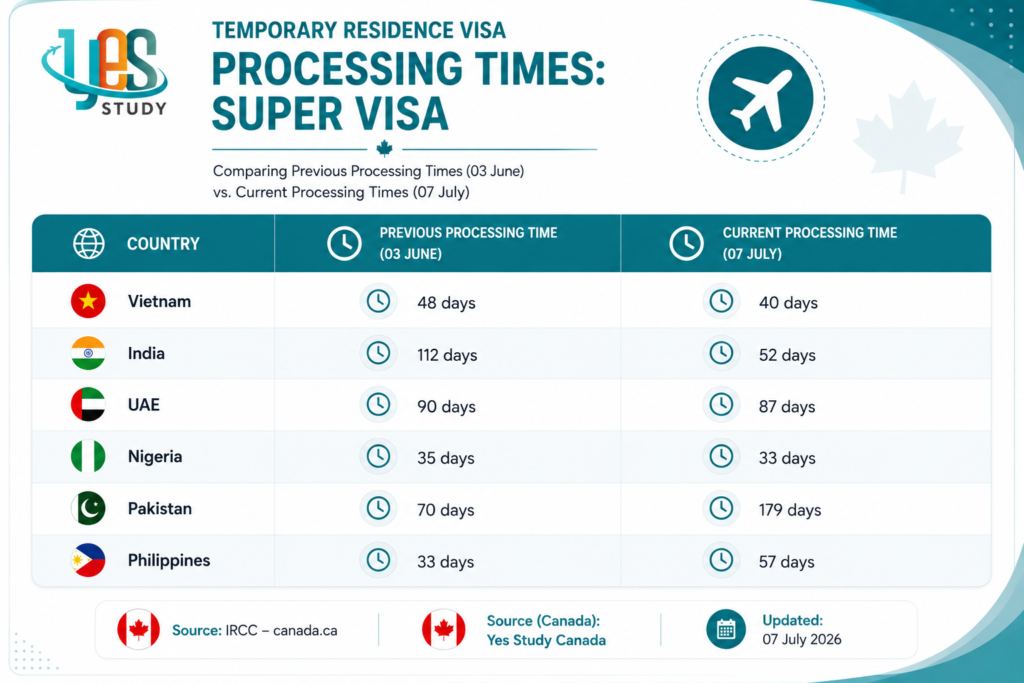
- Super Visa: This multi-entry visa for parents and grandparents allows longer stays.
- As of mid-2026, Super Visa applications are currently taking approximately 60-120 days (2-4 months) to process, depending on the applicant’s country of residence and the volume at the visa office. Some countries, like India, have seen processing times as low as ~28 days.
Note that the Super Visa has unique financial and insurance requirements.
Study permit processing times
For international students, timely processing of study permits is crucial:
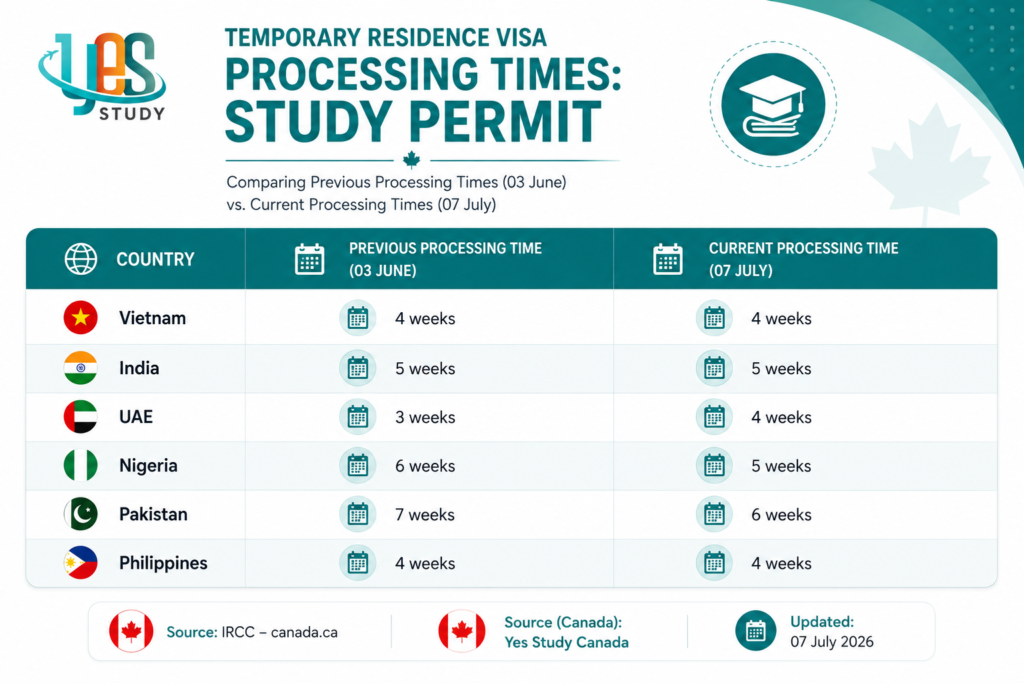
- Initial Study Permits (outside Canada): As of July 2026, study permit processing times vary significantly by country, with a full country spread ranging from approximately 1 to 37 weeks.
- It’s important to note that the Student Direct Stream (SDS) was discontinued on November 8, 2024. All new applicants, including from former SDS countries, now use the regular study permit stream, meaning the 20-day fast-track is no longer available.
- Peak submission season (May through July) can add 2-4 weeks to processing.
- For studies in Quebec, an additional 4-8 weeks are needed to obtain a Certificat d’acceptation du Québec (CAQ) before IRCC can finalize the study permit.
- Study Permit Extensions (inside Canada): Applying online to extend your study permit while already in Canada typically takes about 60 to 80 days (7-12 weeks). During this time, you maintain ‘implied status,’ allowing you to continue studying under the conditions of your expired permit.
Having all required documents like a Letter of Acceptance (LOA) and proof of funds (e.g., a GIC) ready from the outset is key to a smoother application, especially with the discontinuation of SDS.
Work permit processing times
Securing a work permit is a vital step for many. Here are the 2026 timelines:
- Employer-Specific Work Permits:
- LMIA-based (Temporary Foreign Worker Program): This involves two stages. First, the employer needs a Labour Market Impact Assessment (LMIA), which takes 4-8 weeks. After a positive LMIA, the work permit application itself takes another 4-8 weeks from most countries, potentially 8-12 weeks from high-volume countries like India or Nigeria. Total elapsed time can be 8-16 weeks if straightforward, but 20+ weeks if there are issues.
- LMIA-exempt streams (e.g., International Mobility Program, CUSMA professionals, Spousal Open Work Permits for spouses of study-permit holders): These typically process faster, often in 4-6 weeks from most countries, as they skip the LMIA stage.
- Open Work Permits:
- Post-Graduation Work Permits (PGWP): For online inland applications, processing is approximately 90-180 days (3-6 months) as of July 2026. Some reports indicate faster approvals, with some cases taking 1-2 months or even 16-60 days. Paper applications and those from outside Canada typically take 4-7 months. If you apply before your study permit expires, you can work full-time under implied status.
- Bridging Open Work Permits (BOWP): For those awaiting a permanent residence decision, current BOWP processing times are approximately 2-4 months on average, but can be up to 7 months for some. Some Reddit users reported approval in 2 months in 2026. You can apply for a BOWP when your current work permit will expire within 4 months and you have received your Acknowledgement of Receipt (AOR) for your PR application.
- Spousal Open Work Permits: Applying from outside Canada can take 10 to 15 weeks, while inside Canada takes roughly 3 to 4 months.
A positive LMIA is a significant boost to a work permit application, but remember that the LMIA itself has its own processing time. I always advise clients to factor in both stages for LMIA-based applications.
Canada citizenship application times
For those looking to officially become Canadian citizens, here are the general processing times for 2026:
The processing time for a grant of Canadian citizenship is approximately 12 months, measured from the day IRCC receives a complete application to the oath ceremony. This process involves several stages, including eligibility assessment, background checks, a citizenship test (if required), and the final oath ceremony. As of May 2026, the inventory for citizenship grant applications was over 321,000. The fastest path might be around 6 months if there are no complications and test/oath scheduling is quick.
It’s important to remember that before even applying for citizenship, permanent residents must meet significant physical presence requirements (1,095 days within the last five years) and tax filing obligations, which adds to the overall timeline of becoming a citizen.
Permanent resident (PR) card processing times
The PR Card is essential for permanent residents, especially for re-entry to Canada:
- Initial PR Card: For new permanent residents, the initial PR card is typically mailed within a specific period after landing in Canada. Always confirm the current estimate via the IRCC tool.
- PR Card Renewal: As of July 2026, the current published service standard for PR card renewal is approximately 37 days for online applications with complete documentation. However, paper applications can take 2-3 months.
- To renew your PR card, you must demonstrate compliance with the residency obligation, meaning you have been physically present in Canada for at least 730 days within the last five years.
If your PR card expires while you are outside Canada, you may need to apply for a Permanent Resident Travel Document (PRTD) to return to Canada. This emphasizes the importance of planning renewals well in advance.
Managing your application while it’s processing
Once your application is submitted, the waiting game begins. Knowing how to monitor its progress and what to do if delays occur is crucial for managing expectations and taking appropriate action.
How to check your Canada visa application status online
The primary method for tracking your application status is through your IRCC Secure Account (formerly MyCIC):
- Log in or create an account: If you applied online, use the same account you used for submission. If you submitted a paper application, you might need to link it to your online account.
- Navigate to your application: Once logged in, you’ll see a list of your applications. Click on the relevant one.
- Interpret status updates: IRCC provides various status updates such as ‘Submitted’, ‘In Review’, ‘Biometrics collected’, ‘Medical exam passed’, ‘Background check in progress’, ‘Final decision’, or ‘Decision made’. These updates indicate the current stage of your application.
The online tool provides the most current information available to applicants, and IRCC updates it as your application progresses through different stages. Regularly checking this portal is the best way to stay informed about your application’s journey.
What to do if your application is delayed or taking longer than expected
It can be frustrating when your application seems to be taking longer than the published estimates. Here’s what you can do:
- Verify against published times: First, confirm that your application has genuinely exceeded the *published* processing time for 80% of similar cases on the official IRCC tool. Remember, these are estimates.
- Use the IRCC Web Form: If your application has indeed passed the estimated processing time, the IRCC Web Form is the most effective way to inquire about your status. Provide your application number, unique client identifier (UCI), and specific details about your query.
- Contact IRCC by phone (within Canada): If you are in Canada and the web form hasn’t yielded a satisfactory response after a reasonable period, you may call IRCC’s client support centre. Ensure you have your application details ready.
- Request assistance from a Member of Parliament (MP): As a last resort for significant, unexplained delays, a Member of Parliament representing your electoral district can often make inquiries on your behalf. This avenue should be pursued only after you have exhausted direct communication with IRCC and your application is well beyond the estimated processing time.
It’s important to clarify that simply “being anxious” is not a valid reason for contacting IRCC before the estimated time has elapsed. Patience and strategic follow-up are key here. We always advise our clients to keep meticulous records of all communications with IRCC, including dates and reference numbers, which can be invaluable if you need to escalate an inquiry.
Essential tips to avoid delays and expedite your application
While you can’t truly ‘speed up’ IRCC’s processing, you can significantly influence your application’s efficiency by being prepared and meticulous. These proactive steps can help you avoid unnecessary delays.
Ensuring application completeness and accuracy from the start
The single biggest factor in avoiding processing delays is submitting a complete and accurate application package from day one. In my years of experience, I’ve seen that incomplete applications are the most common reason for setbacks, often leading to returns or long delays while IRCC requests missing information.
Here’s how to ensure your application is as robust as possible:
- Read the instruction guide thoroughly: Every program has a specific guide and document checklist. Follow them meticulously for your particular visa or permit type.
- Gather all required documents in advance: Do not wait until the last minute. Obtain police certificates, educational credential assessments, and official translations well before your application deadline.
- Double-check every form and document: Ensure all fields are filled, signatures are present where required, and supporting documents precisely match the requirements (e.g., certified translations, clear copies). A common mistake is forgetting to sign a form, which can cause an immediate return and restart of the clock.
- Provide clear, legible copies: Use high-quality scans for online submissions. Avoid blurry images or hard-to-read text, as these can prompt IRCC to request better copies, causing delays.
Understanding and submitting biometrics and medical examinations promptly
For many Canada visa and permit applications, including permanent residence, study, work permits, and some TRVs, biometrics and a medical examination are mandatory. These steps are critical, and delays in their completion directly halt your application’s progress.
- Biometrics: After submitting your application, you will receive a ‘Biometric Instruction Letter’ (BIL). You must submit your fingerprints and photo at a designated Service Canada location (within Canada) or a Visa Application Centre (VAC) (outside Canada) within a strict 30-day timeframe. Processing pauses until IRCC receives your biometrics. Booking this appointment immediately upon receiving your BIL can shave weeks off your overall timeline.
- Medical Exams: If required, you must undergo an Immigration Medical Examination (IME) with an IRCC-approved panel physician. The physician will send the results directly to IRCC. While you don’t send the results yourself, you are responsible for ensuring the exam is completed promptly after receiving instructions. Any delays in scheduling or completing the exam will directly extend your application’s processing time.
Proactive steps to streamline your application process
Beyond completeness and prompt submission of biometrics/medicals, there are several other proactive steps you can take to ensure a smoother application journey:
- Keep copies of everything: Maintain a well-organized record of all submitted forms, supporting documents, receipts, and correspondence with IRCC. This is invaluable for reference or if IRCC requests clarification.
- Update IRCC on significant changes: Promptly inform IRCC of any changes to your contact information (address, phone, email), marital status, family composition (e.g., birth of a child), or employment status via the IRCC Web Form. An outdated address could mean missing critical communication.
- Respond promptly to IRCC requests: If IRCC asks for additional documents, clarification, or an interview, respond as quickly and thoroughly as possible. Delays on your part directly translate to delays in your application processing.
- Consider professional help: For complex cases, navigating Canada’s immigration system can be challenging. Consulting with a Regulated Canadian Immigration Consultant (RCIC) or an immigration lawyer can prevent costly errors, ensure your application is complete, and provide expert guidance. We at Yes Study are committed to providing such support, leveraging our extensive experience to simplify your journey.
- Use online applications: Whenever a program offers both online and paper application options, choose the online portal. Online applications are generally processed faster than paper-based submissions.
Frequently asked questions about Canada visa processing times
How accurate are the IRCC processing times listed online?
IRCC processing times are estimates based on how long it took to process 80% of recently completed applications in a given category, typically over the last 6-12 months. They are not guarantees or maximums, and individual applications can take longer or shorter. It’s crucial to check the official IRCC website regularly, as these estimates can fluctuate due to application volumes, policy changes, and operational capacity.
Can I speed up my Canada visa application?
Generally, you cannot directly ‘speed up’ an IRCC application. However, you can significantly contribute to a timely process by submitting a complete and accurate application from the outset, responding immediately to all IRCC requests (for biometrics, medicals, or additional documents), and ensuring all supporting documents are correct and legible. While there’s no official fast-track for most temporary visas, rare humanitarian or compassionate grounds might be considered for urgent processing in very specific, limited circumstances.
What happens if my visa expires while my extension application is processing?
If you submit an application to extend your status (e.g., study permit, work permit, visitor record) *before* your current temporary resident status expires, you will benefit from ‘maintained status’ (also known as implied status). This means you can legally remain in Canada and continue to work or study under the conditions of your expired permit until a decision is made on your new application. This policy is crucial for continuity of status for those already in Canada.
How do biometric submissions affect processing times?
For most applications requiring biometrics, processing by IRCC typically pauses until your fingerprints and photo are received. Applicants usually receive a ‘Biometric Instruction Letter’ and must submit their biometrics at a designated center within 30 days. Delays in booking or attending this appointment, or in the biometrics office transmitting the data to IRCC, will directly extend your overall processing time. Prompt submission is critical to avoid unnecessary delays.
Are processing times different for applicants inside and outside Canada?
Yes, processing times can vary significantly depending on whether an application is submitted from inside or outside Canada. This variation is common for temporary resident visas (visitor, study, and work permits), due to differences in visa office workloads, regional policies, and specific program criteria. For example, a visitor visa extension applied for inside Canada will have a different timeline than an initial visitor visa applied for from outside Canada. Spousal sponsorship also distinguishes between ‘inland’ and ‘outland’ applications, though their overall processing times can be similar.
Conclusion
Navigating the Canadian immigration landscape in 2026 demands patience, diligence, and a clear understanding of Canada visa processing times. As we’ve explored, these timelines are dynamic estimates, reflecting IRCC’s operational realities rather than fixed guarantees. The official IRCC website remains your most crucial and up-to-date resource, and we strongly recommend checking it regularly.
To maximize your chances of a smooth application process, the key takeaways are clear: prioritize submitting a complete and accurate application package from the very beginning, proactively manage mandatory steps like biometrics and medical exams, and know how to effectively check your status and address any unexpected delays through official channels. While the journey to Canada can sometimes be uncertain due to fluctuating timelines, diligent preparation and constant vigilance will significantly enhance your experience.
At Yes Study, we are dedicated to supporting you through every step, providing accurate information and expert guidance to help you achieve your Canadian dreams. Remember to verify all dates and policies for 2026 to ensure your plans are based on the most current information available.
